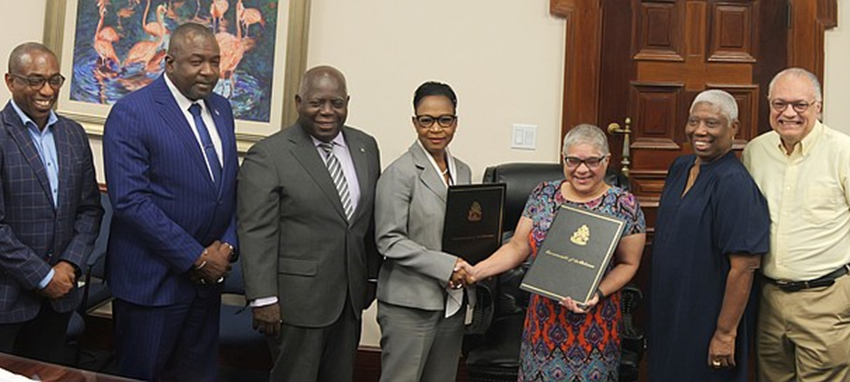
It is our hope that the cultural community and in particular those at the Dundas Centre for the Performing Arts now see who their friends are in the political realm and work to ensure that the PLP returns to office. That is our first thought as the Government signed an MOU with the Dundas Centre for the Performing Arts to improve and upgrade the theatre complex on Mackey Street, the home of Winston Saunders, Clement Bethel and before them Meta Cumberbatch. The theatre has fallen into grave disrepair and there seemed to be no rescue in sight until the PLP came along. The Prime Minister visited the performances one night and determined that the government would supply the funding to get the theatre refurbished. The agent for the change was and is Ian Poitier, who recently returned from London, trashed and discarded by the FNM after regime change and is now back to be able to put in place some lasting support with creating a school for the arts, support for the Dundas and a new performing arts centre. It’s PLP all the way baby. Almost half a million dollars of public funds are to be committed to the project.
This letter first appeared in the Nassau Guardian 11 February 2025
Dear Editor,
Whenever it is permitted to govern, the Free National Movement (FNM) unfailingly works against the interests of the majority of Bahamians.
Its record is one of protecting concentrated wealth, increasing an already high tax burden on the poor, never raising the minimum wage, reversing advances toward universal healthcare and selling off public assets.
In opposition, it has opposed every beneficial development from independence to national insurance to the defence force to National Health Insurance.
None of this is by accident nor is it a result of individual failings among the members or leadership of the party. It is simply a reflection of how the party came into existence, how it is funded and (hence) who it is actually working for.
While the games and antics of personality-focused politics fixate both the media and the population, the big-picture reality of our two parties is that one is basically beneficial to the long-term interests of most Bahamians, while the other is basically harmful to them.
This has never fundamentally changed over the course of our modern history and those of us who thought it could (for a brief moment after 1992) have been proven embarrassingly wrong.
So why, with its record, does the Free National Movement still sometimes get elected?
The answer is simple: because the Progressive Liberal Party (PLP) allows it to.
Bahamians are neither masochists nor fools. As the long run from 1967 to 1992 demonstrates, they will loyally vote for their obvious interests until the issues are allowed to be fudged and obscured by a governing party that begins to stray from its own better instincts.
When the PLP finds itself believing that foreign investment inflows are an objective in and of themselves, or that impressive tourist numbers will magically morph into broad benefits for Bahamians, it not only buys into a myth, but it lays the foundation for a return of the FNM – which will in turn apply these harmful trickle-down fallacies with even greater vigour.
In a country whose basic problem is never a lack of wealth, but an historic tendency to distribute it from the poor to the rich and a related failure to invest it in a more equitable society, only a PLP government can ever do the things (like raising the minimum wage, increasing social and capital spending and finding ways to make the rich pay more for it than the poor) that will not only benefit our economy, but also ensure reelection. Yet remarkably, it has often strayed from that easy formula.
Former Prime Minister Perry Christie’s initial plan for a single-payer National Health Insurance scheme would surely have seen him reelected had he not delayed the matter interminably, watering it down with profit-oriented baggage proffered by the medical and insurance industries to ensure either failure or inefficacy.
As a result, the wealthy Bahamas lags Jamaica and Barbados in terms of internationally-recognized universal healthcare goals, Bahamians are still being financially wiped out by medical emergencies and we frankly look like fools to our region and the world.
Today, the most important matter facing the government is the urgent and obvious need for a substantial increase in the minimum wage (or an actual livable wage), both to reflect the wealth and cost structure of this country and to address a socio-economic imbalance that manifests itself in everything from bad dietary choices to our ridiculously high violent crime rate.
By all means should this government tout its success in attracting billions of dollars of investments and unprecedented tourism numbers. But without positive actions to channel these achievements into the service of the majority of Bahamians, it runs the risk that the public will once again conclude (wrongly, but understandably) that there is no difference between the two parties and will opt once again for the far worse of the two.