On behalf of the Progressive Liberal Party, Senator Fred Mitchell has welcomed the action of Wayne Munroe Q C to challenge the lawfulness of the orders and the proclamation in the Covid 19 crisis. The public has lost patience with the matter. This puts them at odds with the government. The challenge is a representative action, like class actions in the United States. It seeks amongst other things to declare unlawful all the crimes which the Prime Minister made up during this crisis. The names of the other lawyers joining him are: Damian Gomez Q C, Wallace Rolle, Christina Galanos, Uel Johnson, Ryan Brown, Devard Francis, Claude Hanna, Damian White, David P Cash, Alex Morley, Jomo Campbell, Owen Wells, Kahlil Parker, Regina Bonaby, Robyn Lynes, Ryszard Humes, Keith Seymour and Meryl Glinton. Good luck to them.
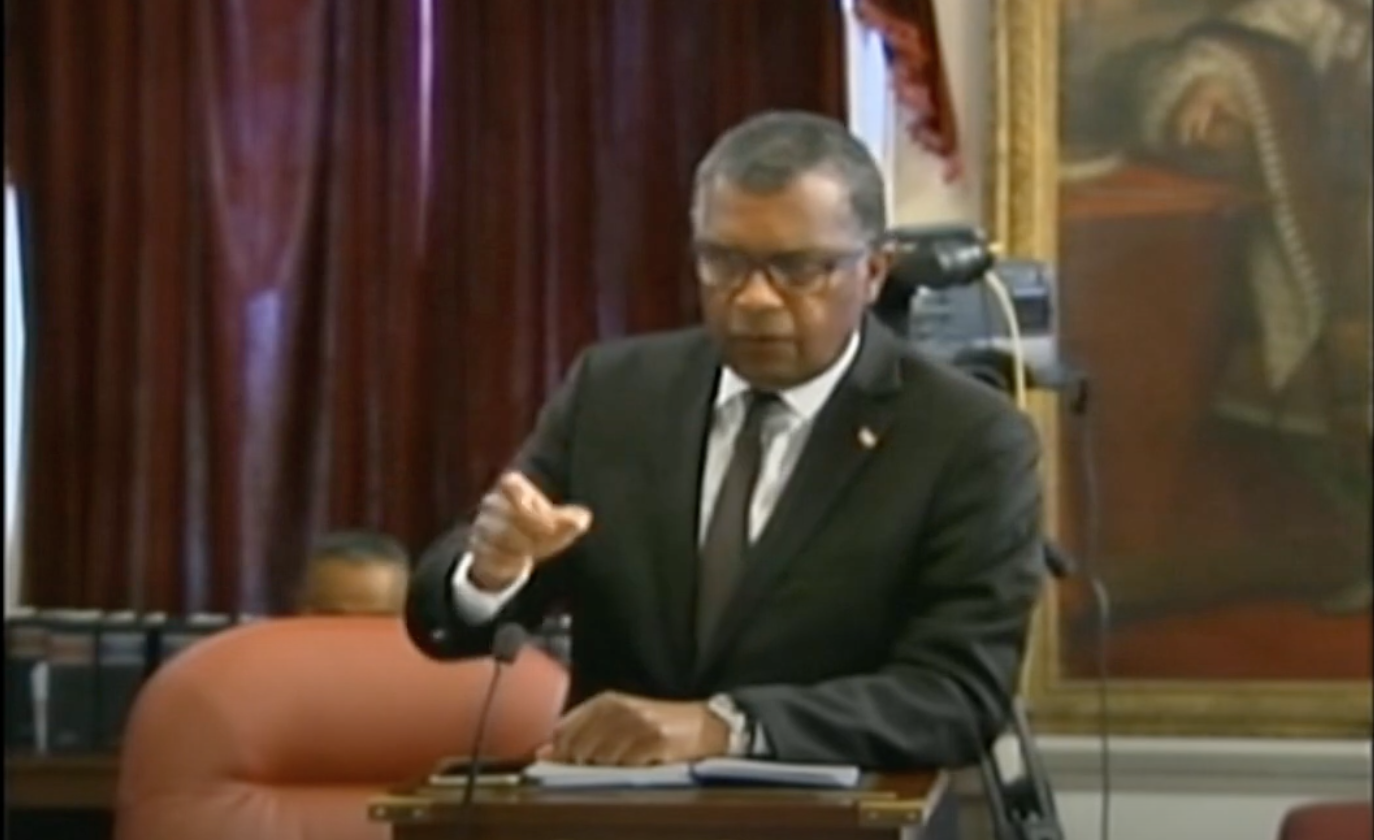
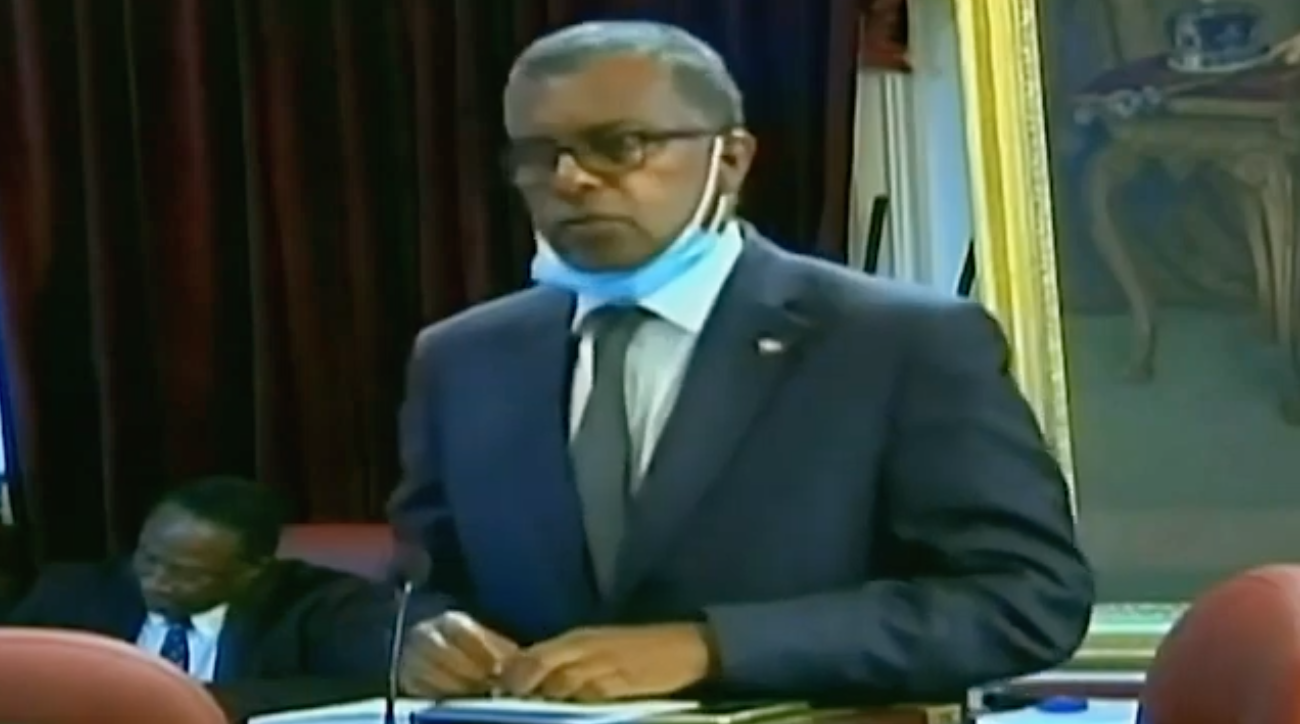
The cut and thrust of the PLP opposing the extension of the emergency proclamation on Friday 24 July 2020 in the Senate. Senator Jamal Moss is put in his place… Senator Carl Bethel is put in his place… He condemns the Prime Minister for his off hand invitation to the Leader of The Opposition. The Prime Minister is named as the one who created this latest Covid mess by his political negligence…speaking up for the Arawak Cay, Montagu, Potter’s Cay vendors, speaking up for the Fox Hill boys who sell guineps, suggesting police carry a box of masks in their cars to give away…and the PLP moves to amend the date on which the proclamation should end … the running time approximately 38 minutes…
We hope this information proves valuable and our young leaders learn how Parliamentary debate should be conducted.
“What we are seeing now from the prime minister is the corrupting influence of power…
“The true emergency is in the House of Assembly…
“It’s gotten to the point now where, obviously, there are no emergencies dealing with COVID…
“The emergency may reappear after today when we start letting Americans and other foreigners into our country.
“But it seems that the continued use of the emergency powers is one of three things, I think. It’s either out of spite, out of the corrupting influence of power and control, or it may also be to do with trying to keep the crime and murder figures down.
“Now, I know there are influences on the competent authority, who he has to listen to, one being the minister of national security. But as for people’s civil liberties, no, nothing is more important to the Bahamian citizens than those freedoms.
“I think the real state of emergency is our Parliament and how it is being managed.”
The prime minister announced on March 19, 2020 that he was invoking the provisions of Article 29 of the constitution to decree a proclamation of emergency under which a number of emergency regulations and orders have been legislated to address the crisis arising from the coronavirus.
The emergency regulations and orders put in place a number of measures such as a 24 curfew, a complete lockdown on weekends as well as limits on the number of people who can gather in one place and imposed a six-feet physical distancing requirement on gatherings.
Under the circumstances, at that time, the cessation of the civil liberties of the citizens and residents of The Bahamas was reasonably justifiable.
However, in my view, the restrictions on those fundamental rights have been left in place for too long.
The prolonged application of the proclamation of emergency and its draconian procedures is dangerous and unnecessary.
The almost daily amendments to the emergency powers orders are confusing and give the appearance, rightly or wrongly, that the competent authority is intending to stretch the incursions on our liberties to the maximum extent possible.
The frequent adjustments to the orders offer too much opportunity for speculation and conjecture of political manipulation.
These repeated amendments and the consequential fear, anxiety and panic they cause to the citizens and their psyche are exactly why Justice Louis Brandeis sounded the following warning: Experience teaches us to be most on our guard to protect liberty when the government’s purposes are beneficent.
It is my view the proclamation of emergency ought to have ended after the initial 14-day period.
Legislation with accompanying practical institutional measures could have then been enacted to replace them. Some of these measures could have included continued enforcement of physical distancing, wearing of masks in gatherings, limits on the number of people at social gatherings, the closure of facilities where crowds usually gather such as nightclubs, theatres, and schools and ban on international and local travel.
I did not include churches in the grouping above because I believe that the church (collective) missed an ideal opportunity to put together its own regulations for worship and for ministering to the people. By missing this opportunity and for its almost total absent voice in this time of crisis, the church has lost much credibility to the extent that some are now questioning their motives and value to the society.
The passage of the legislation to replace the emergency proclamation together with the enforcement of the appropriate protocols would have afforded the government the results it was seeking.
They could have achieved this without taking away people’s fundamental rights and the resulting panic it caused.
There is no logic in having the population out and about Monday through Friday and then impose upon it a complete lockdown on Saturdays and Sundays. The virus is spread only on weekdays?
Moreover, why lockdown adults at nine o’clock every night for weeks on end when only a small percentage of the population is out at nights?
It is easier for the police to drive around and check various business establishments and popular meeting spots than to be at numerous intersections in the hot sun checking IDs.
The right of citizens to move about freely in their country or their right to assemble in small crowds ought not to be abridged for so long a period.
The people should be allowed to move about while obeying the laws and operating guidelines outlined by the medical community.
The coronavirus is not likely spread by people driving their vehicles or walking the streets.
I read a report that indicates that 90 percent of coronavirus infections are spread at homes, in the workplace, public transport, social gatherings and restaurants.
Another report advocates that people should be permitted to move around in the fresh, clean air as immunity is increased by exposure to pathogens on the outside while immunity is greatly weakened by staying in sterile environments indoors.
I would like to see the proclamation of emergency revoked or allowed to die an uneventful death on May 30.
There is no need for the extension of the emergency powers now reposed in the competent authority.
It seems perilous and overly burdensome for these powers to be reposed in the prime minister for 30 days without parliamentary review or oversight.
Why would he want this type of control over the lives of Bahamians for so long a period?
It is time for the people to demand their right to move about and to assemble.
It is time for commerce to reopen with normal hours, so that consumers could have broader choices and there is a little more levelling of the playing field.
By this letter, I am not minimizing the dangers and risks to essential workers that are inherent in this insidious virus.
Rather, I verily believe that we can experience the same level of competence and protection without the continued loss of fundamental rights.
I am reminded of Benjamin Franklin’s caution: They who can give up essential liberty to obtain a little temporary safety deserve neither liberty nor safety.
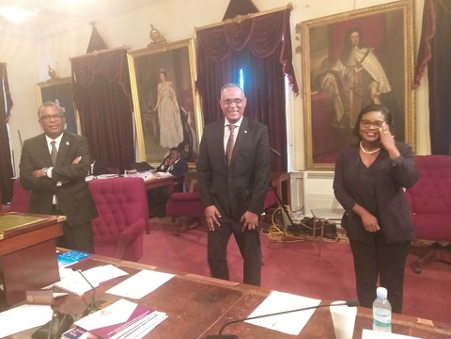
Senator Fred Mitchell, Senator Michael Darville, Senator Jobeth Coleby Davis at the Senate today 30 March 2020 with physical distancing measures in place for the debate on extending the state of public emergency until 8 April 2020.
Health officials yesterday
confirmed community transmission of the coronavirus (COVID) in The Bahamas
This comes as four more cases
of the virus were confirmed on New Providence – none of which were connected to
any of the previous five cases.
Community transmission means
the source of infection for the spread is unknown.
“Based on the cases, the
contacts and where they are, and the onset of the symptoms, we have determined
that it is community spread,” said Dr Mercline Dahl-Regis, Bahamian public
health expert with specialty in regional disease elimination.
Dahl-Regis is the former
chief medical officer and consultant to the prime minister.
Officials warned on Sunday that
while the numbers were increasing slowly, the health system was bracing for a
surge in COVID-19 cases.
“We have been in the
preparatory phase in the last three of four days for a surge,” Dahl-Regis
assured.
“We are now in the surge as
far as our population response and the tests are becoming positive so we are
monitoring the clinical presentations.
“We have an active hotline.
We are looking at the contact tracing, we are monitoring the contacts.”
She furthered that their
teams are now in the process of plotting areas where the cases are occurring to
address the clusters.
“We do have to GIS map our
contacts and our cases so that we can look at interventions or modalities of
moving forward and where to anticipate cases.,” she said.
The first four cases of the
virus were in New Providence and were all connected.
The fifth case in Grand
Bahamas had no connection with the previous cases and had no significant travel
history.
Here is the text of the Proclamation and the Regulations Thereunder
PROCLAMATION OF EMERGENCY
WHEREAS Article 29(1) of the Constitution recognizes that
the Governor- General may make a proclamation that a state of public emergency exists;
AND WHEREAS Article 29(4)
of the Constitution provides that a proclamation of emergency shall, unless it
is sooner revoked by the Governor- General, cease to be in force at the
expiration of a period of fourteen days beginning on the date on which it was
made or such longer period as may be provided under paragraph (5) of this
Article, but without prejudice to the making of another proclamation of
emergency at or before the end of that period;
AND WHEREAS Article 29(5)
of the Constitution provides that if at any time while a proclamation of
emergency is in force (including any time while it is in force by virtue of the
provisions of this paragraph) a resolution is passed by each House of
Parliament approving its continuance in force for a further period, not
exceeding six months, beginning on the date on which it would otherwise expire,
the proclamation shall, if not sooner revoked, continue in force for that
further period; AND WHEREAS I am satisfied that due to
the confirmation of the presence of Covid 19 in The Bahamas, a state of
public emergency exists in The Bahamas as a result of the aforementioned
circumstances;
NOW THEREFOR, I, The Most
Honourable Cornelius Alvin Smith, Governor-General of the Commonwealth
of The Bahamas, in exercise of the powers conferred upon me by Article 29 of
the Constitution of the Commonwealth of The Bahamas HEREBY DECLARE that:
(a) with effect from the 17th day of March, 2020, a state of
public
emergency exists in The Bahamas;
(b) this proclamation of emergency shall cease to be in force at the
expiration of a period of fourteen days from the date hereof, or such longer
period as may be provided for by a resolution passed by each House of
Parliament approving its continuance in force for a further period, not exceeding
six months, beginning on the date on which it would otherwise expire, the
proclamation shall if not sooner revoked, continue in force for that further
period.
Dated the 17th day of March, 2020
Governor-General
GOD SAVE THE QUEEN
—
EMERGENCY POWERS (COVID
19)(NO. 1) ORDER, 2020
In exercise of the powers conferred on me by
regulation 14 of the Emergency Powers (Covid 19) Regulations, 2020, I HEREBY
make the following Order —
1. Citation and
duration.
(1) This Order may be cited as the Emergency Powers
(Covid 19)(No. 1)
Order, 2020. (2) This Order
shall come into force at 9:00 a.m. on the 20th day of March,
2020 and shall expire at 9:00 a.m. on the 31st day of March, 2020.
2.
Curfew.
A curfew is hereby imposed extending each night
from 9:00 p.m. to 5:00 a.m. with such exception as may approved by the
Commissioner of Police.
3. Imposition
of orders.
For every island and cay of
the Commonwealth of The Bahamas, for a period of eleven days commencing the
20th day of March, 2020 —
(1) All establishments, institutions, businesses,
offices, stores and organizations shall suspend operations to the general
public except for the following — (i) wholesale or retail grocery stores and
Farmers’ Markets from
6:00 a.m. to 5:00 p.m.;
(ii) doctor’s offices, hospitals or medical facilities; (iii) pharmacies from
6:00 a.m. to 5:00 pm.; (iv) gas stations from 6:00 am. to 5:00 p.m.; (v)
medical supply establishments; (vi) hotels; (vii) banks from 9:00 a.m. to 5:00
p.m.; (viii) commercial ports and related businesses from 6:00 a.m. to
5:00 p.m.; (ix)
airports;
Page – 2
EMERGENCY POWERS (COVID
19)(NO. 1) ORDER, 2020
(x) laundromats and wash houses for hygienic
purposes from
6:00 a.m. to 5:00 p.m.;
(xi) drive thru or take away food vendors from 6:00 a.m. to 7:30
p.m.; (xii) construction
companies carrying out any construction work
from 6:00 a.m. to 7:00 p.m.
(xiii) such other businesses or undertakings as may be specifically
exempted in writing by the Competent Authority,
Provided that the owner or operator of the establishment specified in (i) –
(xiii) restrict the number of customers inside their place of business at any
one time so that each customer is enabled to distance himself at least three to
six feet (3 – 6 ft.) from any other person.
Every person in such establishment or business must
distance themselves from other persons at a minimum of three to six (3 – 6 ft.)
feet from any other such person. (2) No person shall host or attend —
(i) a private party which includes any person from
outside of the
immediate household of the
house occupant; (ii) a recreational or competitive sporting event; (iii) a
wedding which hosts ten or more persons other than the bride, bridegroom,
official witnesses and the marriage officer; (iv) a banquet, ball or reception;
(v) any social event; (vi) a funeral, except ten members of the immediate
family and
at least one officiant and
essential mortuary staff; or (vii) a meeting of a fraternal society, private or
social club or
civic association or
organization. (3) No person shall offer for hire or seek to travel on any
—
(i) public bus transportation; (ii) mail boat,
sailing inter island, except for transport of freight;
or (iii) inter island
private commercial sea transport that is non-
essential; Provided that the Competent Authority
may vary any of the requirements above by Order.
Page – 3
EMERGENCY POWERS (COVID
19)(NO. 1) ORDER, 2020
(4) No person shall visit any place of quarantine or
isolation
station. (5) No person shall be permitted to visit any
detainee in a correctional facility nor more than one person at any time shall
visit a patient in a hospital or residential care establishment or facility.
(6) Subject to the provisions of this Order, every person shall remain in
the confines of their dwelling home, inclusive of
their yard space.
I HEREBY further order
that —
(7) Nothing in this Order shall —
(a) affect the function by essential officers of
the Royal Bahamas Police Force, The Royal Bahamas Defence Force, Fire Services,
the Department of Correctional Services, the National Insurance Board, the
Department of Social Services, the Department of Environmental Health Services,
the Department of Immigration, the Customs Department, waste and sanitation
workers, and staff within any hospital or health care or medical facility; (b)
affect the function by essential officers of any water, electricity or other
sector encompassing the provision of electronic communications including print
and electronic media; (c) prohibit religious or educational instruction,
worship or other
activity by electronic or
virtual means; (d) prohibit individual attendance at a church for private
individual prayer while
maintaining social distancing. (8) Subject to paragraph 3(1) herein, all other
establishments, institutions, businesses or offices inclusive of the Public
Service (as may be authorised by the respective Permanent Secretary) shall work
from home and such establishments, institutions, businesses or offices shall
maintain only essential staff for the performance of core functions while
adhering at all times to social distancing as prescribed above. (9) Any person,
company or organization who contravenes any order given herein is liable upon
summary conviction to a fine not exceeding ten thousand dollars or to a term of
imprisonment not exceeding eighteen months or to both.
Made this day of , 2020
PRIME MINISTER
Page – 4
—
EMERGENCY
POWERS ACT (CHAPTER 34)
EMERGENCY POWERS (COVID 19)
REGULATIONS, 2020
In exercise of the powers
conferred by section 3 of the Emergency Powers Act (Ch. 34), the Governor-General
makes the following regulations —
1. Citation and
duration.
(1) These Regulations may be cited as the Emergency
Powers (Covid 19)
Regulations, 2020. (2)
These Regulations shall be deemed to have come into force on the 17th
day of March, 2020. (3)
These Regulations shall cease to have effect when the proclamation of emergency
in pursuant of which they have been made ceases to have effect.
2.
Interpretation.
“Competent Authority” means the Prime Minister; “Covid 19” means
the novel Coronavirus (2019-n CoV); “correctional officer” has the same
meaning as in the Correctional
Services Act, 2014; “infected
place” has the same meaning as in the Quarantine Act; “isolation” in
relation to a person means the separation of that person from any other person
in such a manner as to prevent infection or contamination with Covid 19 — (a)
at an isolation station as defined under the Health Services
Act (Ch. 231); (b)
in that person’s home; (c) in a hospital; or (d) at another suitable place; “health
officer” has the same meaning as in the Health Services Act; “statutory
purpose” means the preservation of the public health, peace, maintenance of
public order and the securing and regulating of the supply and distribution of
food, water, fuel, light and power and other necessities.
Page – 2
Emergency Powers (Covid 19)
Regulations, 2020
3. Detention of
persons.
(1) Where —
(a) a health officer has reasonable grounds to
believe that a person is, or
may be, infected or
contaminated with the Covid 19; and (b) the health officer considers that there
is a risk that the person might
infect or contaminate
others; or (c) a person has arrived in The Bahamas on an aircraft or ship
from
outside The Bahamas; and
(d) the person has left, or the health officer has reasonable grounds to
believe the person has left, an infected place within the twenty day period
immediately preceding the date of the person’s arrival in The Bahamas, the
health officer may, for the purposes of screening, assessment and the
imposition of any restrictions or requirements under regulation 4, impose on
that person a requirement to be detained until the later of—
(i) the end of the period of forty-eight hours
beginning with the time from which the person’s detention under this regulation
begins; (ii) such time as any screening requirements imposed on or in relation
to the person under regulation 4(1) have been complied with and the assessment
referred to in that regulation carried out in relation to the person. (2) Where
a special restriction or requirement is imposed under this regulation, the
person imposing the restriction or requirement must express it to be contingent
on the incidence or transmission of Covid 19 constituting a serious and
imminent threat to public health.
4. Imposition
of restrictions and requirements.
(1) Where a person has been detained pursuant to
regulation 3, the health
officer may— (a) orally or in writing, impose on or
in relation to any person one or more screening requirements to inform an
assessment, of whether such person presents or could present a risk of
infecting or contaminating others; (b) carry out such an assessment in relation
to that person; (c) following such an assessment, orally or in writing, impose
on or in relation to that person any other restriction or requirement which the
health officer considers necessary for the purposes of removing or reducing the
risk referred to in subparagraph (a), including a special restriction or
requirement.
Page – 3
Emergency Powers (Covid 19)
Regulations, 2020
(2) A decision to impose a restriction or
requirement under paragraph (1) may only be taken if the health officer
considers, when taking the decision, that the restriction or requirement is
proportionate to what is sought to be achieved by imposing it. (3) A
restriction or requirement imposed under paragraph (1) by a health
officer may be varied,
orally or in writing, by the health officer. (4) Where a restriction or
requirement under paragraph (1)(c) is imposed on or in relation to a child, a
person who is a responsible adult in relation to the child must ensure that the
child complies with the restriction or requirement, insofar as that person is
reasonably able to do so. (5) Where a restriction or requirement is imposed
orally on a person under this regulation, or a restriction or requirement
imposed under this regulation is orally varied, the person (or, in the case of
a child, a person who is a responsible adult in relation to the child) must be
provided with a written notification of the restriction or requirement that has
been imposed or varied as soon as reasonably practicable. (6) Where a special
restriction or requirement is imposed under paragraph (1) (c), the person
imposing the restriction or requirement must express it to be contingent on the
incidence or transmission of Covid 19 constituting a serious and imminent
threat to public health. (7) Paragraph (1) does not affect the exercise of any
powers by virtue of
regulation 5.
5. Isolation of
persons suspected to be infected with Covid 19.
(1) A health officer may require a person be kept
in isolation, if the health
officer — (a) has reasonable grounds to believe
that a person is, or may be,
infected or contaminated
with Covid 19; and (b) considers that it is necessary and proportionate to do
so in order to reduce or remove the risk of the person infecting or
contaminating others. (2) Where a health officer has reasonable grounds to
believe that a person is, or may be, infected or contaminated with Covid 19,
the health officer may detain the person pending the decision of the health
officer under paragraph (1). (3) Where paragraph (1) applies, the health
officer may impose on or in
relation to a person one or
more screening requirements. (4) Where a special restriction or requirement is
imposed under this regulation, the person imposing the restriction or
requirement must
Page – 4
Emergency Powers (Covid 19)
Regulations, 2020
express it to be contingent on the incidence or
transmission of Covid 19 constituting a serious and imminent threat to public
health.
6. Screening
requirements
(1) For the purposes of these Regulations, the
screening requirements in
relation to a person means the person must — (a)
answer questions about the person’s health or other relevant circumstances,
including travel history and information about other individuals with whom the
person may have had contact; (b) produce any documents which may assist a
health officer in
assessing the person’s
health; (c) allow a public health officer, or such person designated by the
public health officer to take a biological sample of the person, including a
sample of the person’s respiratory secretions or blood, by appropriate means
including by swabbing the person’s nasopharyngeal cavity, or provide such a
sample; and (d) provide sufficient information to enable the person to be
contacted immediately by a health officer during such period as the health
officer may specify. (2) Where a person is a child and accompanied by a
responsible adult, the
responsible adult must — (a) ensure that the child
answers questions in accordance with
paragraph (1)(a); (b)
answer the questions if the child is unable to do so or cannot
reliably do so; (c) produce
any documents, required under paragraph (1)(b), on such
child’s behalf; (d) allow
the health officer to take a biological sample of the child, including a sample
of such child’s respiratory secretions or blood, by appropriate means including
by swabbing such child’s nasopharyngeal cavity, or provide such a sample; and
(e) provide information under paragraph (1)(d) to the health officer as
required.
7. Power to
requisition any building, ship or aircraft, etc..
(1) Where the competent
authority is satisfied that it is reasonably required for any statutory purpose
so to do for the duration of the emergency or any period therein, the competent
authority may give notice, in writing, to the person having control of any
building, ship in The Bahamas, or of any aircraft or article of any description
in The Bahamas, of having requisitioned a building, ship, aircraft or
article.
Page – 5
Emergency Powers (Covid 19)
Regulations, 2020
(2) Where the competent
authority requisitions any building, ship, aircraft or article under paragraph
(1) the competent authority may, by itself, its servants or agents, take
possession of the building, ship, aircraft or article and do to or in relation
to such building, ship, aircraft or article, anything which might lawfully have
been done by the owner of such building, ship, aircraft or article as if such
building, ship, aircraft or article had not been requisitioned under these
Regulations, and may use such building, ship, aircraft or article for any
purpose for which such building, ship, aircraft or article might lawfully have
been used if it had not been so requisitioned. (3) At the conclusion of the
requisition, the competent authority shall make prompt and adequate compensation
in the circumstances to the owner or occupier of such building, ship, aircraft
or article.
8. Power to
requisition essential services.
(l) Where the Governor-General is satisfied that it
is reasonably required so to do for the duration of the emergency or any period
therein, he may give notice in writing for the requisition of any essential
service to the person having the management or control of any essential service
requisitioning such service with effect from such date as may be specified in
such notice. (2) Where any essential service is requisitioned under paragraph
(1), the Governor-General shall by instrument in writing appoint some person as
controller of the service requisitioned. (3) Upon the appointment of some
person as controller of any essential service, such person shall be entitled to
take possession of all premises and assets of every description (other than
money or securities for money) which, immediately before the giving of the
notice by which such service was requisitioned, were used or intended to be
used for the purposes of such service and, in relation to any premises and
assets so taken possession of, and in relation to the service so requisitioned,
to do or cause to be done any act or thing which might lawfully have been done
by the person having control of such service if the service had not been so
requisitioned. (4) For the purposes of these Regulations, “essential
services” means any service established, maintained or operated by the
Government, or by any public or private enterprise, or otherwise, for — (a) the
collection, storage, purification or distribution of water for use
by the public or any class
of the public; (b) the collection, storage, treatment and disposal of sewage or
garbage
or refuse; (c) the manufacture,
storage or distribution of gas for use by the public
or any class of the public; or
Page – 6
Emergency Powers (Covid 19)
Regulations, 2020
(d) the removal, handling or burial of deceased
persons or disposal of
dead animals. (5) The
provisions of regulation 7(3) shall apply mutatis mutandis.
9. Power to
waive procurement rules.
(1) In the interest in protecting the public safety
and health, the competent authority, in consultation with the Minister of Finance,
may by order, waive the application of any rules or law governing the
procurement of goods and services. (2) The Minister of Finance shall within six
weeks of the expiration of the Proclamation of Emergency lay a report before
the House of Assembly detailing — (a) the total expenditure of the goods and
services procured; (b) the suppliers of the goods and services procured; (c)
the reasons for the use of the suppliers of the goods and the
providers of the services.
10. Power to
waive fees.
The competent authority may
by order waive or vary the payment of any fees for the testing and medical
services rendered at any public hospital or health care facility in relation to
Covid 19.
11. Reporting
requirements.
The Minister of Health, the
Managing Director of the Public Hospital Authority and the person charged with
responsibility for directing the day to day operations of any other entity or
public body charged with responsibility for protocols with respect to Covid 19,
shall report to the competent authority during the continuance of the public
emergency.
12. Revocation
or suspension of permits for use of public open spaces.
The competent authority may
by order, cause to be revoked or suspended all permits for the use of public
open spaces in any particular area, or an entire island or the country as a
whole in the interest of public health safety.
13. Prohibition
of assembly.
The competent authority may
by order prohibit the assembly of two or more persons in a public place in any
area specified, in the interest of public health safety.
Page – 7
Emergency Powers (Covid 19)
Regulations, 2020
14. Imposed
social distancing or isolation.
(1) The competent authority may by order, impose
isolation on all individuals within a particular area, island or the entire
country in the interest of public health safety. (2) Where isolation has been
imposed, the competent authority may —
(a) require the closure of all educational or
religious institutions in the
area so specified; (b) require
the closure of any business or organization that caters to the general public
in the areas so specified, unless permitted otherwise by the order; (c)
prohibit the visitation by persons at all residential care
establishments; (d)
prohibit the visitation by persons at all correctional facilities; (e) require
every person to confine himself at his place of residence,
unless otherwise specified
by the order; (f) permit the travel of persons to a grocery store, gas station,
pharmacy, doctor, hospital or such other place as may be specified in the
order. (3) An order made pursuant paragraph (1)(e), shall not prohibit a person
from
going outdoors within the
enclosed yard space of that person’s residence. (4) The competent authority may
by order issue guidelines on social
distancing and isolation, which shall have the
force of law.
15.
Curfew.
The competent authority
may, by order, require every person within any area specified in the order to
remain within doors between such hours as may be specified in the order, and
any person who within any area so specified is or remains outdoors between such
hours without a permit in writing from the competent authority, or some person
duly authorized by the competent authority, commits an offence.
16. Restriction
of access to any area.
(1) The competent authority may, by order, prohibit
a person from residing or entering any area specified in the order if such
person is suspected of acting or of having acted, or of being about to act, in
a manner prejudicial to — (a) the public safety; (b) the supply or distribution
of any necessity of life; or (c) the preservation of the peace,
Page – 8
Emergency Powers (Covid 19)
Regulations, 2020
and the competent authority is satisfied that it is
desirable that such person should be prohibited from residing in or entering
any particular area, the competent authority may, by order, prohibit him from
residing or entering any such area or areas as may be specified in the order.
(2) Upon the making of an order under paragraph (1), the person to whom the
order relates shall, if he resides in any area so specified, leave that area
within such time as may be specified in the order, and shall not subsequently
reside in or enter any area so specified during such time as may be specified
in the order.
17. Power to
stop, detain and arrest.
(1) Where an authorized person has reasonable cause
to believe that a person is in violation of these Regulations, he may stop,
detain, question and arrest such person if he considers it necessary so to do.
(2) Any person who assaults, obstructs, hinders or resists or uses any
threatening or abusive language or aids or incites any other person to assault,
obstruct, hinder or resist any authorized person in the execution of his duty
under this regulation, commits an offence. (3) For the purposes of these
Regulations, an authorised person means —
(a) any member of the Royal Bahamas Police Force or
a peace
officer; or (b) any person
authorized by the competent authority to do the act in
relation to which the expression is used.
18.
Obstruction.
No person shall obstruct
any health officer, public officer, any member of the Royal Bahamas Police
Force, the Defence Force, any peace officer, or any correctional officer,
acting in the course of his duty as such, or any person exercising any powers
or performing any duties conferred or imposed on him by or under any of these
Regulations, or otherwise discharging any lawful functions in connection with
the performance of any statutory purpose.
19. Publication
of false statements.
No person shall publish or
cause to be published, posted or re-posted, over any media platform inclusive
of social media, any purported news or report, or purported statement of fact,
knowing or have reasonable cause to suspect that the same —(a) is untrue
or false; or
(b) may incite public fear, panic or ethnic
hatred.
Page – 9
Emergency Powers (Covid 19)
Regulations, 2020
20.
Governor-General may authorise international or regional forces.
The Governor-General may authorize such
international or regional military or police forces as may be requested by the
Government to serve as peace officers and assist in — (a) the storage, safe
keeping or distribution of relief supplies; (b) the provision of any essential
services; and (c) the maintenance of public order.
21. Publication
of order.
(1) Any order made pursuant to these Regulations
may be published —
(a) by announcement on any television or wireless
transmission by any media duly licensed to operate for transmission and
reception in The Bahamas; (b) by notice affixed to the outside of magistrate
courts, police stations located in the area of The Bahamas and to the outside
of every Administrator’s office on the Family Islands to which the order applies;
or (c) by notice on the official website of the Government, except that as soon
as practicable thereafter the order shall be published in the Gazette. (2) The
means of authentication for notices published pursuant to subsection
(1) shall be — (a) in the case of media
announcements under paragraph (1)(c)(i), the
voice of the Prime
Minister; (b) in the case of posted notices under subsection (1)(c)(ii), the
actual
or electronic signature of the Prime Minister. (3) Notwithstanding
the provisions of section 31 and 32 of the Interpretation and General Clauses
Act (Ch. 2), an order made under these Regulations shall have effect
notwithstanding that the order has not been published in the gazette or laid
before the House of Assembly.
22. Repugnancy
with other enactments.
These Regulations shall
have effect notwithstanding anything inconsistent therewith contained in any
enactment, and any provision of an enactment which may be inconsistent with
these Regulations or any such order made in accordance with these Regulations
shall, whether or not that provision has been amended, modified or suspended in
its operation under section 3 of the Act, to the extent of such inconsistency
have no effect so long as these Regulation or any such order remains in
force.
Page – 10
Emergency Powers (Covid 19)
Regulations, 2020
23. General
penalty.
Any person who contravenes
the provisions of any of these Regulations or any order made or notice given
thereunder or incites or attempts to incite any other person to contravene any
of these Regulations or any order made or notice given thereunder commits an
offence and is liable upon summary conviction before a magistrate to a fine not
exceeding ten thousand dollars or to a term of imprisonment for a term not
exceeding eighteen months or to both.