Tag: reform

  • The Bahamas Cannot Afford to Ignore Electoral Reform Any Longer

    The Bahamas Cannot Afford to Ignore Electoral Reform Any Longer

    Abigail Cartwright writes from Dean’s Blue Hole

    There are many lessons to be learned from the last general election in The Bahamas, but one issue that deserves urgent national attention is electoral reform — particularly the state of the voters register.

    One of the most striking observations after the election came from Bruce Golding, head of the Commonwealth Observer Group. He openly noted that many of the recommendations repeatedly made by international observers continue to be ignored election after election. That level of frustration should concern every Bahamian who values democracy and public trust in the electoral process.

    Equally troubling were reports of voters arriving at polling stations with valid voter’s cards, only to discover that their names were missing from the register. That cannot simply be brushed aside as “human error.” The right to vote is one of the most fundamental rights in a democracy, and any system that prevents eligible citizens from exercising that right weakens public confidence.

    At the same time, the national conversation about “low voter turnout” requires greater context and understanding.

    Before 2017, voter registration was tied more directly to election cycles. People registered because they intended to vote in an upcoming election. Naturally, turnout percentages appeared higher. However, since the introduction of a continuous voter register in 2017, the list of registered voters has steadily grown year-round.

    The numbers tell the story:
• 2017: 181,543 registered voters
• 2021: 194,525 registered voters
• 2026: 209,245 registered voters

    A continuous register is not inherently a problem. In fact, it is a modern and necessary system. But if the register is not routinely cleaned and updated, it can create a misleading picture of voter participation.

    Today, the register likely includes persons who have died, missing, permanently relocated, imprisoned, stopped voting for religious or personal reasons, or registered without any intention of participating in elections. When these names remain on the list, turnout percentages can appear artificially low, fueling public criticism and mistrust.

    If this issue is not addressed urgently, the consequences could be serious:
• declining public confidence in election results,
• increased misinformation and conspiracy theories,
• inaccurate constituency data,
• opportunities for electoral abuse,
• and continued voter frustration and disengagement.

    Election reform must become a national priority. And any serious reform effort should begin with one simple but critical step: cleaning up and modernizing the voter register so that it accurately reflects the active voting population of The Bahamas.

    -Abigail Cartwright

  • THE NEED TO CONSIDER PENSION REFORM

    THE NEED TO CONSIDER PENSION REFORM

    The following was a statement first published in a voice note by the Chairman of the PLP Fred Mitchell on 20 August 2025 on pension reform:

    As I was canvassing Fox Hill, and as it often happens, I got an interesting and pleasant surprise. A lady who is retired spoke to me and I asked her if she needed anything. She explained the hassle she anticipated getting the noncontributory pension from National Insurance. I offered to help but she refused. She said she was fine. It was too much paperwork for the amount you would ultimately yet, but she added that in her working life she had anticipated the retirement and took steps to ensure that she was comfortable in her retirement. 

    Thanks she said but no thanks. That was a complete change from the usual demands and attitudes of entitlement that you hear around.

    We are now reviewing the parliamentary pensions account of each Member of Parliament or Senator, so they will know what the pension will be if they retire today. When I received the figure from the office, I understood what so many people experience upon retirement. If I retired today, I simply could not live off the pension. 

    Those in a similar situation then are forced to work, continue to work or become supplicants on public largesse.

    When Lynden Pindling, put in place, the pension arrangements for MPs, he argued that it was to improve the lot of the generation of the politicians before him who ended up impecunious as a result of public service. Yet he himself suffered at the end of his life 25 years ago. And you suffer in the face of an unforgiving public.

    In my case, it’s no one’s fault that the result is what it is. I made the choices and I stand by those choices. As Perry Christie, likes to say: “it is what it is,” There will be enough to bury me for sure. Cremation, of course. At the end, I think I’ll be okay. And there’ll be enough somehow. 

    Why is this an important discussion? From a public policy point of view, it is important because we face a declining birth rate, a low replacement level, older population, the urgency of healthcare issues like dementia and other non-communicable diseases, pension reform to correct a huge burden on the government’s coffers, that is unsustainable and the public education that is required.

    Public education should show the public that your finances are your personal obligation, not the government’s obligation primarily. The government is a backstop, not the primary obligant.

    This is all the more so because the morals and values of the generation behind us, do not seem to share the Christian notion that you are your brother’s keeper, as they literally dump their loved ones on the public hospital system and abandon them to a death of loneliness.

    My late friend Mario Donato of Grand Bahama used to say to me,” Fred, do me a favour? Don’t get old.” He was a rich man, and went to his grave asking that favour. I understand now more than ever what he meant. Let us commit ourselves as a country to planning our futures better. This applies to both young and not so young.

  • LAND LAW REFORM

    LAND LAW REFORM

    In 1968 Lynden Pindling was elected with his most popular victory ever. In the speech from the throne, the Governor promised that land reform would be coming. That never came during the Pindling administrations.  Now it’s Brave Davis’ turn and two generations later, the PLP is seeking to tackle the problem of land titles in The Bahamas. The Land Registration Bill and the Land Adjudication Bill threatens to do that if passed and brought into force. The Prime Minister described it at a seminar of Parliamentarians as a revolution in land law. We agree. Land purchases take too long here and you are never certain whether you in fact have a good title to land.  These bills should solve the problems of conveyancing.

  • PINTARD A THIEF OF IDEAS: BANKING REFORM IS NOT HIS IDEAS

    PINTARD A THIEF OF IDEAS: BANKING REFORM IS NOT HIS IDEAS

    If you read the press last week, and just landed from outer space, you would actually believe that Michael Pintard, the Leader of the Opposition, was the author of banking sector reform in The Bahamas. The only problem is that is a lie.  Mr. Pintard is suddenly jumping on the Fred Mitchell band wagon.  He is a typical political carpetbagger.  He sees a good wicket and tries to take advantage of it. So the he announced a whole raft of measures following Fred Mitchell’s call for the Central Bank to intervene on banking fees.  MR> Pintard then went to see the Central Bank governor and then announces that he is certain that reform is coming.  Bottom line, trying to take credit for something which is not his doing. This is called stealing ideas.

  • BANKING REFORM UNDERWAY MAYBE?

    BANKING REFORM UNDERWAY MAYBE?

    There has been a back and forth in the press now for over two weeks between the Chairman of the PLP Fred Mitchell and the Clearinghouse Banks Chairman Gown Bowe on the need for reform in the banking sector.  Mr. Mitchell has called repeatedly for the Central Bank to take a more aggressive stance with regard to regulating banks and bank fees and making them improve their services as well as restore services to unbanked communities.  The Central Bank has now weighed in publicly with a document which indicates what its views are on reform.  This week the Prime Minister Philip Davis has promised that he will have consultations with the sector about the services which they offer to the Bahamian public.  Let’s hope that reform is coming for real this time, sooner rather than later.

  • ENERGY REFORM IS COMING WHETHER THEY LIKE IT OR NOT

    ENERGY REFORM IS COMING WHETHER THEY LIKE IT OR NOT

    Last week the Free National Movement was in full-throated attack on the PLP’s new energy policy.  Every day they were in the paper about some issue or other about energy reform.  According to them, the reform is not going to work they say that the legislative effort is bound to fail and that the deals that are being struck on LNG are bad deals.  Mind you they have no idea what the deals are.  But Michael Pintard and the FNM should rest themselves.  These are the people who sold BTC and we now have the worst telephone company in the region as a result. They gave away a national asset at a fire sale.  These are the people who are allowing the Grand Bahama Port Authority to get away with gross dereliction of duty in Freeport.  These are the people who gave a monopoly to the Arawak Port people with the resultant high prices at the port. These are the people who gave the food distribution in covid to their friends who promptly fattened their own pockets off the food distribution programme.  They should wear the letter “S” on their foreheads as a mark of shame.  They have no right to talk about BPL and suggest that it is a national sell-off. That is totally false but why would they quarrel since they would know all about selling off a national asset at a fire sale price? They ought to hang their heads in shame.

  • BPL REFORM IS COMING: KUDOS TO JOBETH COLEBY DAVIS

    BPL REFORM IS COMING: KUDOS TO JOBETH COLEBY DAVIS

    JoBeth Coleby Davis is now the Minister for Energy.  It is her job to resolve the age old problem, a generational problem, both in terms of years and as in power generation, of the inability of BPL and its predecessor BEC to provide reliable power to the country.  The Minister gave a comprehensive statement to the House on Wednesday 5 March 2024 about the myriad issues which we face with BPL.  We need 1 billion to settle old and on going debts.  We need another billion to move the project forward.  The Government is entering into a public private partnership to provide stability to the grid and to the generating plant.  If it works, the minister thinks there should be lower prices to the consumer by July of this year.  Lord knows we need something. People are complaining about the high bills and the unreliability of BPL’s supply.  By week’s end two new board members had replaced the two who resigned.  The two who resigned said that their private businesses would no longer allow them to put in the work which is required to accomplish the reform of BPL

  • A COMMITMENT TO CAMPAIGN FINANCE REFORM

    A COMMITMENT TO CAMPAIGN FINANCE REFORM

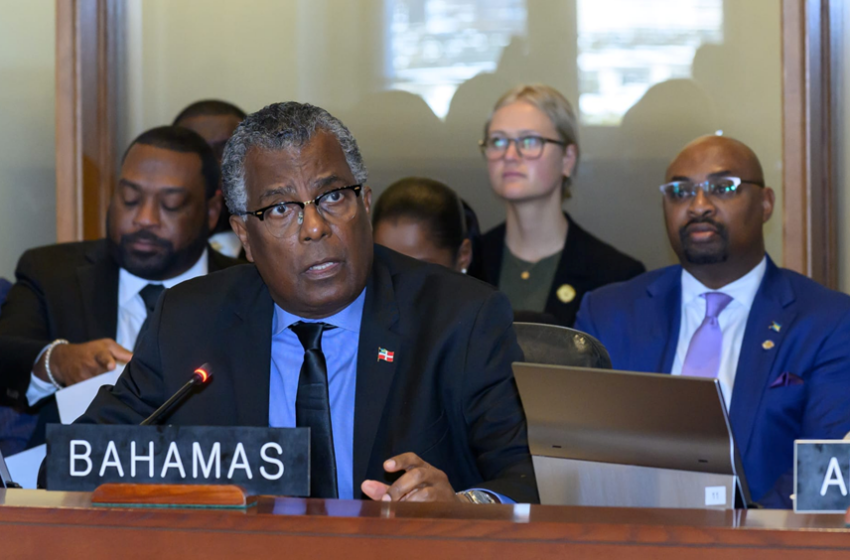
    The Foreign Minister Fred Mitchell spoke at the Organization Of American States at the Permanent Council to respond to the Election Observers Report on The Bahamas and its general election of 2021.  The report was presented formally to the OAS on Wednesday 17 January 2024.  The Government accepted the report and made observations on the following: campaign finance reform, boundaries, access of women to elections with those who are disabled, access to the courts for electoral justice.