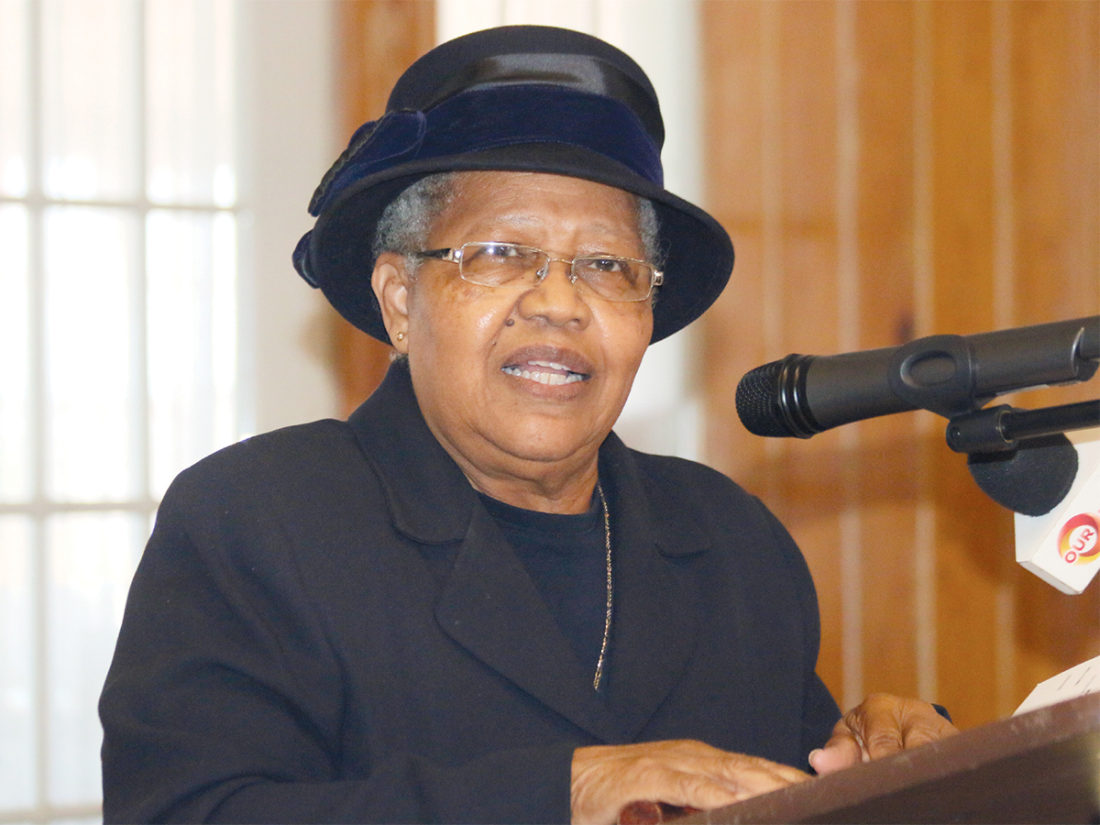
Over the past month, there have been these long anti Haitian rants on social media. The folks have been saying that this was Dame Joan Sawyer, the former Appeal Court Judge, who is known for outburst from time to time but we can assure you that her grammar is always perfect. The note had a woman ranting in bad English. It was clear to us that the notes were not her but the rumours persisted. On Thursday 5 June 2020 Dame Joan addressed the rumours herself, denying that the voice was hers.
Dame Anita on the left and Dame Joan on the right: the battle of the Dames
Last week, the former President of the Court of Appeal now a government employee as Law Reform Commissioner, wrote a public letter defending the Government’s shut down of the country in the face of the Covid 19 pandemic. Her letter came on the heels of a ringing denunciation some days before by Dame Joan Sawyer, Dame Anita’s predecessor as President of the Court of Appeal. Dame Joan takes no last so she struck back with this letter. What a time! What a time!
Dear Madam:
Re: Constitutional validity of house arrest of the majority of citizens and residents of The Bahamas under the purported exercise of emergency powers under Article 29 of the constitution:
I have read with great interest your very learned exposition of the government’s position on the issue of the validity of the many orders and proclamations made by or on behalf of the government by the governor general and the prime minister and noted that the prime minister has today, August 17, 2020, acted in accordance with your recommendation in that exposition.
In effect, you argue, based on the wording of Article 29 alone, that the governor general and the prime minister as the competent authority under the Emergency Powers Act and the regulations and rules made thereunder, may contravene the fundamental rights and freedoms of every person in The Bahamas with impunity once there has been a declaration that a state of emergency exists and that there is no recourse for persons adversely affected by those regulations and orders which are made by “proclamation” rather than the constitutional procedure under Article 52 of the constitution.
It is noteworthy, however, that in your presentation you made no mention of Articles 2, 17, 18, 27 and 28 of the constitution which are also included in Part III of the constitution and which are not mentioned in Article 29.
I intend in this paper to set out all of those provisions which you have chosen not to mention in your paper so that the Bahamian people may decide for themselves whether they wish to live in a country where, on the decision of the oligarchy who have their own agendas, they will accept dictates by such oligarchy based on information from unknown sources and not publicly verified in the usual way in which such matters are required to be verified under the constitution and statutes of The Bahamas.
I begin this discussion by referring to the definition of the term “detention” which is what the orders made by the competent authority have done to all of the citizens and residents of The Bahamas, not just those who are alleged to have been tested positive for COVID 19 (“the virus”) or those who have been in contact with those tested positive for the virus.
By “detention”, I mean, telling us when we can leave our homes, when we can exercise, when we can go to the shops, telling us when we can get married, how and when we can bury our dead relatives, among other things, telling us when we can go to a doctor or a dentist as well as how many of us can go to church at a time, how long we can be in church and so on and so on.
No one, in their right mind would say that a government modelled on the Westminster model of democracy, does not, in a true national emergency, have the power and the duty to, for example, quarantine persons who have infectious diseases.
The difficulty for you and the present administration is that it has exercised an exorbitant power on the pretext that they are concerned to save lives from this “deadly virus” by detaining every person in The Bahamas — except for persons they have in their wisdom deemed “essential workers”.
In rushing to judgment based on an opinion tendered by a retired president of the Court of Appeal and current law reform commissioner under a contract of or for services with the government, no account was taken of the other provisions of the constitution which must be borne in mind when advising a government, which is contemplating making such draconian orders as have been made by the present administration which have become increasingly restrictive of the exercise by ordinary persons of their entrenched human rights of freedom of movement, freedom of conscience, freedom from arbitrary arrest — 17, 18, 27 and 28 which are not specifically.
Even though Article 19 and 20 are referred to in Article 29, it is relevant to note that Articles 18 and 19 also refer to Article 29. Therefore, to read Article 29 as if it stands alone or is superior to the other articles dealing with fundamental rights and freedoms, is disingenuous as well as dangerously misleading.
So that persons interested in discerning the truth may understand what their constitution actually says I set out here the actual provisions to which you did not refer in your opinion posted to Facebook.
Article 2 reads:
“2. – This constitution is the supreme law of the Commonwealth of The Bahamas and, subject to the provisions of this constitution, if any other law is inconsistent with this constitution, this constitution shall prevail and the other law shall, to the extent of the inconsistency, be void.”
This article was part of the basis for the decision of the Court of Appeal and the Privy Council in Thomas D’Arcy Ryan v Attorney General regarding the validity of section 7 of The Bahamas Nationality Act, 1973 in which the impugned provision was held to be void because it conflicted with the provision of Article 5 (2).
Article 17 reads:
“17. – (1) No person shall be subjected to torture or to inhuman or degrading treatment or punishment.”
(2) Nothing contained in or done under the authority of any law shall be held to be inconsistent with or in contravention of this article to the extent that the law in question authorizes the infliction of any description of punishment that was lawful in the Bahama Islands immediately before 10th July, 1973.”
In modern times, the detention of whole segments of a particular populace was practiced by people like Adolf Hitler and Josef Stalin.
The United Nations’ Human Rights Convention as well as the European Convention on Human Rights were directed to the prevention of such excesses for the future yet, here in 2020, the government of The Bahamas has detained not just a segment or segments of the population but the whole population except for those they describe as “essential workers”.
If your argument is correct, there is nothing wrong with the government inflicting torture, or inhuman or degrading treatment or punishment on people who have not been charged with any breach of any law let alone the orders of the administration during a declared period of public emergency.
Before July 10, 1973, there was one occasion when the then governor placed us under martial law and a squad of soldiers from the Gloucestershire Rangers was sent here and billeted in Oakes Field – that was during the general strike of January 1958.
Article 18 prohibits the enslavement of any person in The Bahamas. That Article reads:
“18. – (1) No person shall be held in slavery or servitude.
(2) No person shall be required to perform forced labour.
(3) For the purposes of this Article, ‘forced labour’ does not include –
….(d) any labour required during a period of public emergency (that is to say a period to which Article 29 of this constitution applies) or in the event of any other emergency or calamity that threatens the life or well-being of the community, to the extent that the requiring of such labour is reasonably justifiable, in the circumstances of any situation arising or existing during that period or as a result of that other emergency or calamity, for the purposes of dealing with that situation.”
For example, during Hurricane Dorian and its aftermath, the prime minister declared a state of emergency for Abaco and Grand Bahama because of the sudden and tragic loss of life and property in those Islands caused by that hurricane and although it would have been possible to require persons to help clean up the vast amounts of debris from the destruction wrought by the hurricane, no such order was necessary because there were many volunteers and voluntary organizations both Bahamian and non-Bahamian.
I turn next to Article 19 which guarantees to every person in The Bahamas protection from arbitrary arrest and detention. It is a fairly long article so I will restrict my excerpt to the most relevant provisions in light of the fact that your advice was that the government can detain the whole population once a state of emergency has been declared and nothing contained in or done under the authority of such a law can be held to be inconsistent with Articles 19, 20 – except paragraph 20(4) – or any provision of Articles 21 – 26.
Whether by inadvertence or by design, you made no mention of paragraphs (5), (6) and (7) of Article 19 which apply when a state of emergency has been declared under Article 29. So far as relevant, those paragraphs read:
“19. – (1) No person shall be deprived of his personal liberty save as may be authorised by law in any of the following cases –
…. (f) for the purpose of preventing the spread of an infectious or contagious disease or in the case of a person who is, or is reasonably suspected to be, of unsound mind, addicted to drugs or alcohol, or a vagrant, for the purpose of his care or treatment or the protection of the community.
….
“(5) Where a person is detained by virtue of such a law as is referred to in Article 29 of this constitution, the following provisions shall apply:
(a) “he shall, as soon as reasonably practicable and in any case not more than five days after the commencement of his detention, be furnished with a statement in writing, in a language he understands, of the grounds upon which he is detained.
(b) “not more than fourteen days after the commencement of his detention, a notification shall be published in the Gazette stating that he has been detained and giving particulars of the provisions under which, his detention is authorised;
(c) “He may from time to time request that his case be reviewed under paragraph (d) of this paragraph but, where he has made such a request, no subsequent request shall be made before the expiration of three months from the making of the previous request;
(d) where a request is made under sub-paragraph (c) of this paragraph, the case shall, within one month of the making of the request, be reviewed by an independent and impartial tribunal established by law, presided over by the Chief Justice or another Justice of the Supreme Court appointed by him, and consisting of persons who are Justices of the Supreme Court or who are qualified to be appointed as Justices of the Supreme Court.
(e) he shall be afforded reasonable facilities to consult and instruct, at his own expense, a legal representative of his own choice, and he and any such legal representative shall be permitted to make written or oral representations or both to the tribunal appointed for the review of his case.
“(6) On any review by a tribunal in pursuance of paragraph (5) of this article of the case of any detained person, the tribunal may make recommendations concerning the necessity or expediency of continuing his detention to the authority by whom it was ordered, but, unless it is otherwise provided by law, that authority shall not be obliged to act in accordance with any such recommendations.
“(7) When any person is detained by virtue of such a law as is referred to in Article 29 of this constitution the prime minister or a minister authorised by him shall, not more than thirty days after the commencement of the detention and thereafter not more than thirty days after the making of the previous report, make a report to each House stating the number of persons detained as aforesaid and the number of cases in which the authority that ordered the detention has not acted in accordance with the recommendations of a tribunal appointed in pursuance of paragraph (5) of this article:
Provided that in reckoning any period of thirty days for the purposes of this paragraph no account shall be taken of any period during which the Parliament stands prorogued or dissolved.”
Please correct me if I am wrong in concluding that none of the provisions of those paragraphs have been complied with and certainly none of the names of the persons who you opine have been validly detained have, so far, been Gazetted.
The result is that there is a serious lack of trust in the veracity of the information being given to the public and yet they are being even more drastically restricted in the exercise of their undoubted freedoms guaranteed by the constitution itself – see also Liversidge v Anderson [1942] AC 206 and Regina v Secretary of State ex p. Khawaja [1984] AC 74 at 110.
You also made no reference to Articles 27 and 28 of the constitution. Article 27 protects from deprivation of property without prompt and adequate compensation.
The government has apparently taken over certain buildings belonging to private enterprise. Presumably there are sufficient funds in the Consolidated Fund to pay for these additional expenses and no doubt those expenses have had the necessary approvals under the recently passed budget – see, for example, Attorney-General v De Keyser’s Royal Hotel [1920] AC 508.
Article 28 deals with the enforcement of fundamental rights of any person in The Bahamas. So far as relevant to the issues under consideration, Article 28 reads as follows:
“28. – (1) If any person alleges that any of the provisions of Articles 16 to 27 (inclusive) of this constitution has been is being or is likely to be contravened in relation to him then, without prejudice to any other action with respect to the same matter which is lawfully available, that person may apply to the Supreme Court for redress.
(2) The Supreme Court shall have original jurisdiction –
(a) to hear and determine any application made by any person in pursuance of paragraph (1) of this article; and
(b) to determine any question arising in the case of any person which is referred to it in pursuance of paragraph (3) of this article, and may make such orders, issue such writs and give such directions as it may consider appropriate for the purpose of enforcing or securing the enforcement of any of the provisions of the said Articles 16 to 27 (inclusive) to which the person concerned is entitled:
Provided that the Supreme Court shall not exercise its powers under this paragraph if it is satisfied that adequate means of redress are or have been available to the person concerned under any other law.
(3) If, in any proceeding in any court established for The Bahamas other than the Supreme Court or the Court of Appeal, any question arises as to the contravention of any of the provisions of the said Articles 16 to 27 (inclusive), the court in which the question has arisen shall refer the question to the Supreme Court. …”
It appears from the above provisions that even if the competent authority makes orders, ostensibly to protect the majority of the citizens and residents of The Bahamas from the virus, a person who is detained without reasonable cause to suspect that he/she has the virus or has been exposed to it, would still have the right to sue the government for infringement of his or her constitutional rights and freedoms. And, of course, Article 29 does not, and could not logically refer to this article.
Article 29 of the constitution which, so far as it may be relevant, reads as follows:
“29. – (1) This article applies to any period when –
(a) The Bahamas is at war: or
(b) there is in force a proclamation (in this section (sic) referred to as a ‘proclamation of emergency’) made by the governor general and published in the Gazette declaring that a state of public emergency exists for the purpose of this section(sic).
(2) Nothing contained in or done under the authority of any law shall be held to be inconsistent with or in contravention of Article 19, any provision of Article 20 other than paragraph (4) thereof, or any provision of Articles 21 – 26 (inclusive) of this constitution to the extent that the law in question makes in relation to any period to which this article applies provision, or authorises the doing during any such period of anything, which is reasonably justifiable in the circumstances of any situation or existing during that period for the purpose of dealing with that situation….” (Emphasis supplied)
That provision is like a number of other provisions in the human rights provisions of the constitution which give a government a locus poenitentiae if they are sued for redress by someone who, for example, has been diagnosed as being positive for the virus.
It cannot protect a government which acts on unspecified grounds of belief that every citizen and resident is suspected of having the virus or of being exposed to someone who has or had the virus.
When dealing with anything as delicate and as valuable as human rights and freedoms, we should always bear in mind the reflection by the German Lutheran Pastor Martin Niemoller (1892 -1984) about the cowardice of German intellectuals and certain clergy including by his own admission, Niemoller, himself following the Nazi rise to power and the subsequent incremental purging of their chosen targets, group after group. He said:
“First they came for the socialists and I didn’t speak out because I was not a socialist
Then they came for the trade unionists and I didn’t speak out because I was not a trade unionist
Then they came for the Jews and I didn’t speak out because I was not a Jew
Then they came for me and there was no one left to speak for me.”
Be warned about Dame Joan Sawyer. She is no one’s friend politically. So last week, she went off on the FNM, just as she had on the PLP a few months before and during the election period. The words on Hubert Minnis are helpful to the progressive cause but PLPS should be warned keep your distance. She can turn on you in a minute. She said the lockdown is unconstitutional. Well if she thinks so, she should challenge the law. Here is what else she said to Guardian Radio:
“What they’re doing to you is placing you under house arrest. What they’ve done to us since the 20th of March, 2020 is to put us under house arrest.
“They even tried to tell us what day to go to the food store depending on your surname. You’re trying to micromanage my affairs and you can’t manage the affairs of which we elected you to office.
“You don’t know where your powers end and my freedoms begin.
“You even have the gall to say on public TV that you might have to do something that’s unconstitutional?
“You’re breaching our rights when you lock us down. Who gave you that authority? The constitution gives you the right to declare a state of emergency and it gives you the powers to exercise due process in a situation. You can’t have police coming to my porch and telling me I can’t go on my porch.
“When did we become a police state?”
“… no person shall be held to be guilty of a criminal offense on account of any act or omission that did not at the time it took place constitute such an offense and no penalty shall be imposed for any criminal offense that is severe in degree or description than the maximum penalty that might have been imposed for that offense at the time when it was committed.”
You can not make a crime which was not a crime before.
“I don’t know what world the prime minister is living in.”
Senator Fred Mitchell with Messrs Hubert Ingraham, Perry Christie, Hubert Ingraham and Philip Brave Davis at St Joseph’s for the funeral of the late Joan Clarke. 7 March 2020
The sister of the Hon . A D Hanna, for Governor General and that of former Director of Immigration Barbara Pierre nee Hanna, the aunt of Glenys Hanna Martin and a 42 year former public servant herself Joan Hanna was buried following a service at St Joseph’s Catholic Church in Nassau. Mrs. Clarke rose to the rank of Under Secretary to her retirement in 1997 and served as Assistant Secretary General with her sister Barbara at the PLP’s head office in Nassau.
Last week there was yet another one of these wacky, crazy interventions from the former President of the Court of Appeal Joan Sawyer, a one woman wrecking crew. She helped to torpedo the women’s equality amendment to the constitution. She campaigned vigorously for the removal of the PLP with one wacky statement after the next. Then she attacked Dr. Hubert Minnis who she helped to put in power by saying that his days were numbered. Now she is back again this time to defend the indefensible, the naming of Sir Roland Symonette, the head of the racist United Bahamian Party regime, that was ousted in 1967 and whose ousting gave her a chance to become what she is in The Bahamas. According to the Dame, Sir Roland was more than a National Hero. Why so? Because he loaned his money to people to buy their houses. Nothing like a slave to praise the master. What a shame. Now you see why the Privy Council used to overturn her judgements more than the garbage can by your dogs outside your yard.
We agree with Noelle Nicolls, with whom we normally disagree, that Dame Joan Sawyer is out of place.So we publish what she wrote last week below.Dame Joan Sawyer’s actions are an embarrassment to the country and womanhood.
Top 3 Outlandish Statements from Dame Sawyer that should Really Scare You #DameSawyerLogic
Dame Joan Sawyer is a highly accomplished attorney in the Bahamas, once serving as the Chief Justice of the Supreme Court. For that I have no doubt she is very learned (as the lawyers like to say), and has had to overcome many obstacles – some of them without a doubt because she is a woman – to reach her heights of accomplishment. However, her public statements concerning the upcoming constitutional referendum reflect a disturbing level prejudice and insularity that cannot go unanswered, and should diminish her stature in the eyes of those who believe in human rights and equality for all. On reflection, I must say I am quite relieved Dame Sawyer is now retired; though she may still be influential, I am satisfied that the future does not belong to her.
Last week she delivered remarks on the referendum at a Bar Association event. The video is making its rounds online. Though she said very little about the actual referendum (more on that later), her statements were fully loaded. So my first comments respond to the Top 3 Outlandish Statements that Should Really Scare You:
“I don’t care what they say you must have a firm moral base. When England was Christian it conquered more than two thirds of the world. Where is it now? When Spain was Christian, how much did it have? Where is it now? “Dame Sawyer. Background: Dame Sawyer believes the referendum is leading us down the wrong moral path because it is secretly promoting a homosexual agenda. She wants to bring back Christian values like the good ole days when England and Spain were Christian nations and ruled the world. She laments the collapse of the British Empire as a sign of their moral decay. Oh, the irony. If this doesn’t scare you then it must have gone over your head, so let me break it down. For her moral compass, Dame Sawyer has made the North Star those colonial empires responsible for genocide, slavery and the theft of indigenous lands. For her symbol of Christian righteousness, Dame Sawyer has placed on a pedestal the very oppressors who were responsible for whipping Christianity into the backs of her ancestors; raping and pillaging, and planting their seeds of white supremacy and male patriarchy. She wants us to return to those good ole days when the children of slavers would have been nursing at her breasts and spitting in her face. This is Dame Sawyer’s model for a society with high moral standards and codes of decency and you should be very afraid.
“We are trying to establish a code of decency: public and moral conduct. You cannot build a country on amoral conduct. You cannot build a country on amoral conduct.” Dame Sawyer. Background: More pontificating from Dame Sawyer on the need to resist the secret homosexual agenda in the name of upholding moral standards. She believes no country can truly be built on amoral conduct. If this doesn’t sound like utter rubbish to you then you must have slept through history class. I could draw for many foreign examples, like Belgium or Portugal, or the United States of America that was built on the red skins of Native Americans and the sweat of enslaved Africans. But I will keep things right at home. I only need six words for an abbreviated history of the Bahamas: genocide, slavery, piracy, bootlegging, drugs and cronyism. The building of the Bahamas is a story of amorality, and virtually ALL countries in the modern world share a similar history. So what is Dame Sawyer talking about? Much of the work of activists, especially human rights and women’s rights advocates, is to right the wrongs and correct the injustices perpetuated by the amoral conduct of countries, specifically those that led and the mobs that followed. It is scary that she should be so oblivious.
“You cannot change standards because of your personal problems. Standards must stay in place; they are set as goals for which we ought to strive. Not as soon as it suits us we put them on one side and we accommodate whatever. Where will it end?” Dame Sawyer. Background: Dame Sawyer believes that pushing the referendum and beating the drum of equality (code word for homosexuality) is tantamount to “incessantly” pouring “drivel” down her throat. She believes forcing her to swallow is wrong. The metaphorical equivalent for her is sheepishly following the example of the United States, a country that is “imploding” (not because of racism, white supremacy and obstructionism, but because of a homosexual agenda). She believes Vice President Joe Biden and former Vice President Dick Cheney are US symbols of moral decay, as they shifted their positions on same sex marriage after coming to terms with the sexual orientation of their individual children. Although she has love for the homosexuals in her family she does not condone their lifestyle and rejects any effort to change societal standards on the basis that standards are immovable objects and should be held sacred and free from interference. Now this one is particularly baffling, considering Dame Sawyer is a former judge, a Chief Justice no less. You don’t have to be a lawyer, a judge or a legal scholar to know or to understand that the legal system is designed to function in the EXACT way that Dame Sawyer is rebuking. Laws represent standards. Not God decreed standards; standards invented by people. These standards are upheld, confirmed, propagated by the legal judgments of the courts. These judgments are made in cases, where individuals bring their personal conflicts – their “personal problems” – to be adjudicated on by the courts. The rulings of the court in these personal matters form legal precedents or legal standards. So contrary to Dame Sawyer’s unfortunate tirade, our personal experiences do influence the standards we set and the standards we change. Rightly so, our personal experiences inform how we see the world and new experiences allow us to see the world in an ever evolving manner. Personal experiences allow us to have empathy, understanding, compassion, and to walk in the shoes of others. This is a virtue and the fact that Dame Sawyer sees it as a black hole of iniquity is truly scary.
If you carefully consider her presentation, you will realise Dame Sawyer spoke very little about the actual referendum. Instead she delivered a dog whistle speech preaching about false morality and wild fantasies of a world that does not exist.
To be quite frank, more than our national grade point average being a D, it terrifies me that a woman of these mindsets is supposed to represent the best of us.
So much to say about that speech and I am just warming up. Let’s spread the word about this #DameSawyerLogic. Plus, check out my “5 Petty Responses to Dame Sawyer cuz she went there”. And stay tune for My Dead Serious Rebuttal of Dame Sawyer on the Referendum. #DameSawyerLogic
Lynn Holowesko, former President of the Senate and Co-Chair of the Yes Vote Campaign, wrote this thoughtful letter to the editor in response to the ill-considered remarks for former President of the Court of Appeal Dame Joan Sawyer on the four referendum bills which she considered a waste of time, even though Dame Joan claimed she had not read the bills:
The glaring headline in your paper [The Nassau Guardian] of Monday 25 April 2016 is reflective of the shock I felt on reading the article below the headline. It is not merely disappointing to read that a person of Dame Joan Sawyer’s standing in our community would admit that she “ has not yet seen the questions” but that the referendum was “ a waste of time” and if she does vote, she would vote no.
It is surprising that a woman of her intellect, whose profession is to make decisions based on facts and the law, would so willingly undermine her credentials by doing neither.
Countless Bahamian men and women have had their lives negatively impacted by the discrimination presently embodied in the constitution. I am one of them. I know and I have met many, many others.
The referendum seeks to remove that discrimination and give equal rights to Bahamian males and females . Nothing more—nothing less.
Dame Joan might be reminded that Bahamian men and women look up to individuals like her who have achieved so much and has been so highly honoured. For her to make such a callous and uninformed comment about an event so significant in our country’s development is extremely surprising and very difficult to understand.
cialis prostate times;”>The Mother in Law of the Anglican Bishop Florence Gray nee Gibbs was buried following services at Holy Cross Anglican Church in Nassau on Saturday 1st August. The Anglican Bishop Laish Boyd presided. His wife Joan and brother in law Philip, discount cialis who is an executive of the Pharmacy Council are amongst the survivors.