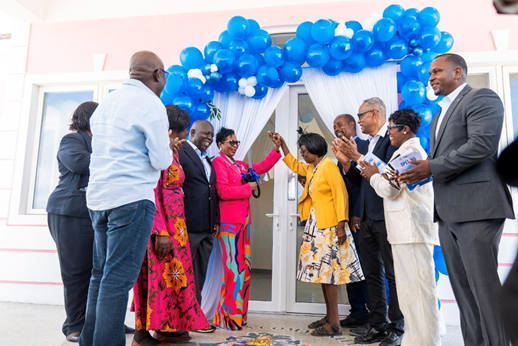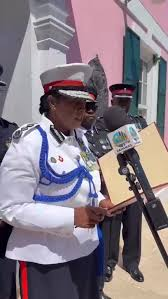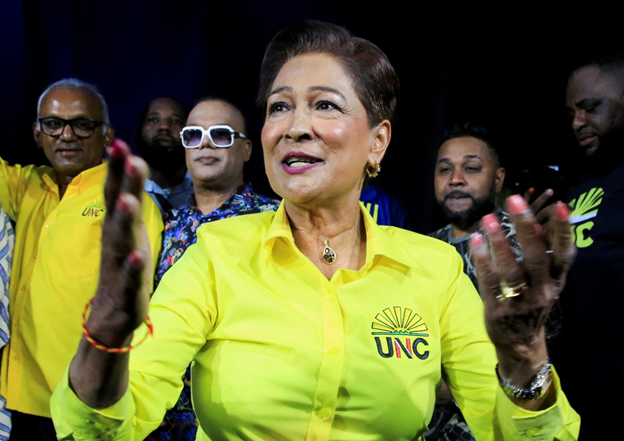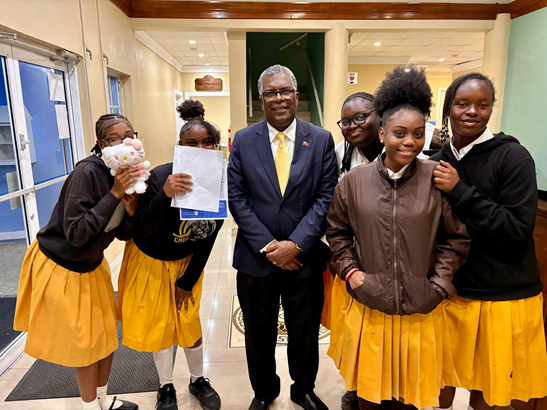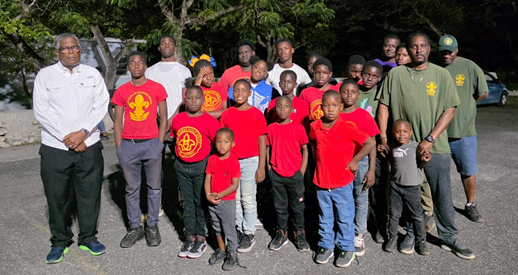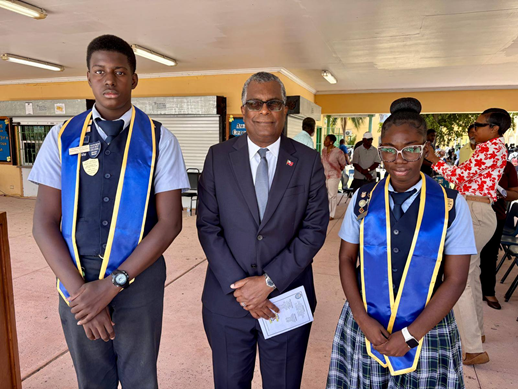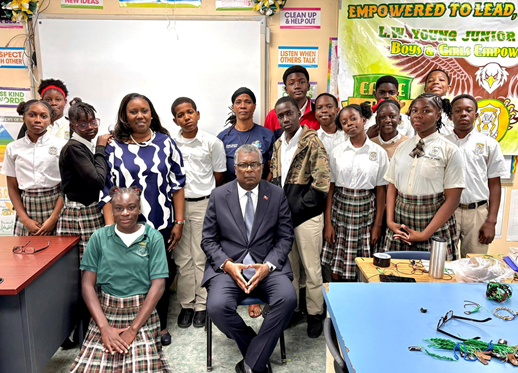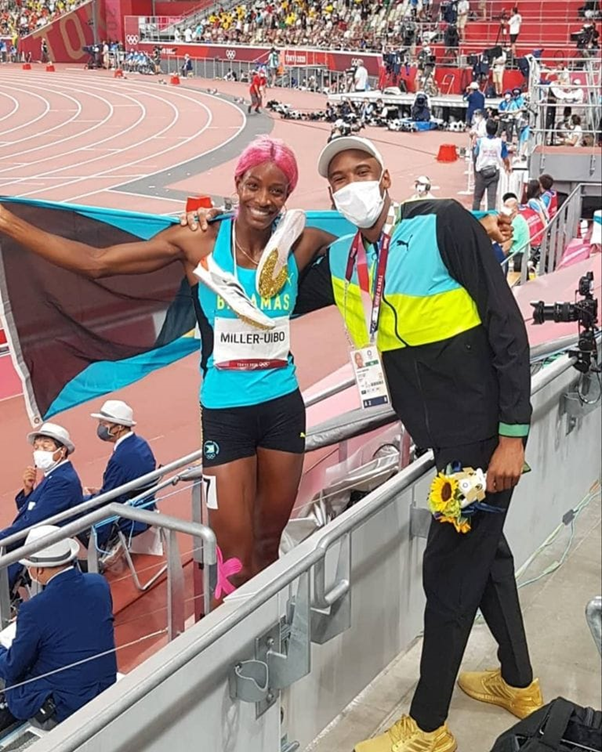
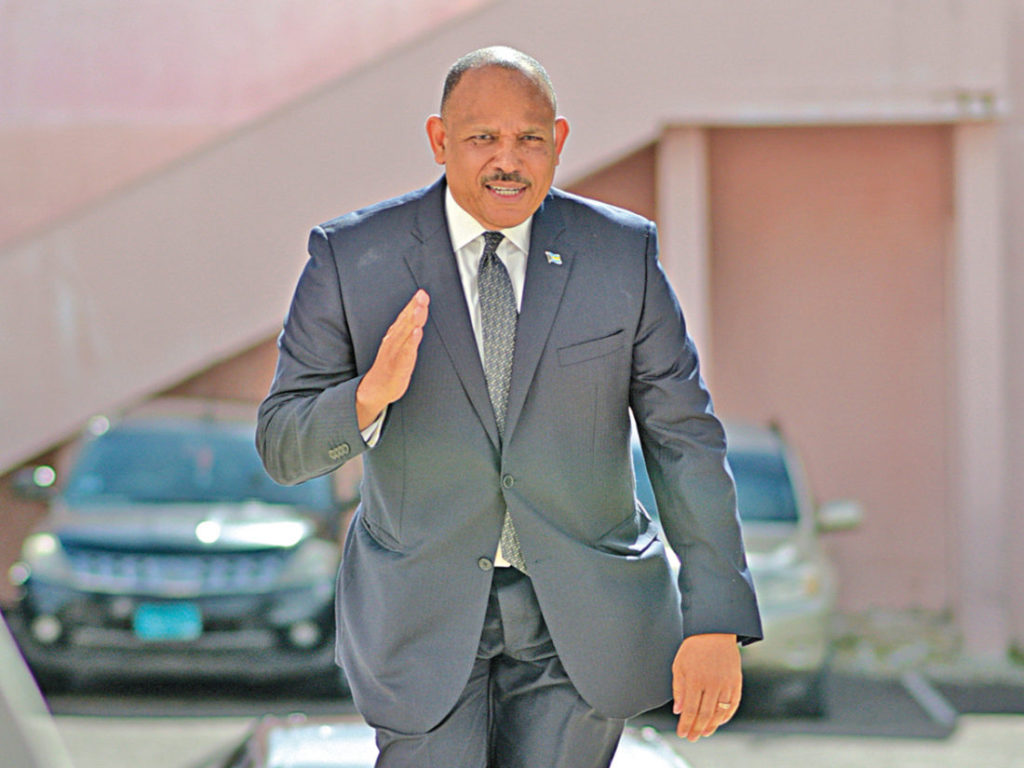
THE MASS RALLY TO ANNOUNCE THE PLP’S CANDIDATES: this was the scene at Gambier House as 15 more candidates were announced by the PLP for the general election this year. Our photo of the week was taken on Thursday 22 January 2026

THE MASS RALLY TO ANNOUNCE THE PLP’S CANDIDATES: this was the scene at Gambier House as 15 more candidates were announced by the PLP for the general election this year. Our photo of the week was taken on Thursday 22 January 2026

In the face of a speech on 21 January 2026 at Davos by the Canadian Prime Minister Mark Carney trashing the actions of the U S President Donald Trump at deconstructing the world order, Donald Trump cancelled an invitation to the Canadian Prime Minister to participate in his Board of Peace to run Gaza. That is the level of pettiness we now have in world affairs.
The Canadian Prime Minister made the comment that few countries are willing or indeed able to stand up to American bullying. The CARICOM countries are all cowering in fear as every week there is some new regulation that effectively imprisons the people of the CARICOM region in their island homes.
Americans can travel freely to our islands, do what they wish there but CARICOM citizens are now subject to all kinds of phony restrictions largely it seems for ideological reasons. The latest is that the citizens of Antigua and Barbuda and Dominica a total of 200,000 altogether now have to post a 15,000 dollar bond to apply for a visa to enter the United States. Dominica’s per capita income is 9,800 dollars. Antigua’s is 23,000 dollars.
The escape from colonialism was no escape at all. To quote the Canadian Prime Minister, we have all been living a lie. Today we are faced with rules that prevent us from traveling where we want. We face rules that prevent CARICOM citizens from saying what we want. Today we face rules that prevent us from buying what we want.
This is quite a mess and the answer of our leaders has really been feckless because they fear that if they resist the bullying as it was called by Mark Carney, the CARICOM countries will face even further restrictions and they will lose their political places.
So the fight for independence from the benign British who were leaving, running out the door, shows us that the real fight now begins.
We hope that what the Prime Minister of Canada said at Davos gives some courage and cover to our leaders in the region. That we all grow some balls.
Number of hits for the week ending Saturday 24 January 2026 up to midnight: 771,583;
Number of hits for the month of January up to Saturday 24 January 2026 up to midnight: 3,248,226;
Number of hits for the year 2026 up to Saturday 24 January 2026 up to midnight: 3,248,226;

This is an excerpt from the address by the Canadian Prime Minister Mark Carney at the Davos Economic Forum on 21 January 2026 in his own words:
Today, I’ll talk about the rupture in the world order, the end of a nice story, and the beginning of a brutal reality where geopolitics among the great powers is not subject to any constraints.
But I also submit to you that other countries, particularly middle powers like Canada, are not powerless. They have the capacity to build a new order that embodies our values, like respect for human rights, sustainable development, solidarity, sovereignty, and territorial integrity of states.
The power of the less powerful begins with honesty.
Every day we are reminded that we live in an era of great power rivalry. That the rules-based order is fading. That the strong do what they can, and the weak suffer what they must.
This aphorism of Thucydides is presented as inevitable – the natural logic of international relations reasserting itself. And faced with this logic, there is a strong tendency for countries to go along to get along. To accommodate. To avoid trouble. To hope that compliance will buy safety.
It won’t.
So, what are our options?
In 1978, the Czech dissident Václav Havel wrote an essay called The Power of the Powerless. In it, he asked a simple question: how did the communist system sustain itself?
His answer began with a greengrocer. Every morning, this shopkeeper places a sign in his window: “Workers of the world, unite!” He does not believe it. No one believes it. But he places the sign anyway – to avoid trouble, to signal compliance, to get along. And because every shopkeeper on every street does the same, the system persists.
Not through violence alone, but through the participation of ordinary people in rituals they privately know to be false.
Havel called this “living within a lie.” The system’s power comes not from its truth but from everyone’s willingness to perform as if it were true. And its fragility comes from the same source: when even one person stops performing — when the greengrocer removes his sign — the illusion begins to crack.
It is time for companies and countries to take their signs down.
For decades, countries like Canada prospered under what we called the rules-based international order. We joined its institutions, praised its principles, and benefited from its predictability. We could pursue values-based foreign policies under its protection.
We knew the story of the international rules-based order was partially false. That the strongest would exempt themselves when convenient. That trade rules were enforced asymmetrically. And that international law applied with varying rigour depending on the identity of the accused or the victim.
This fiction was useful, and American hegemony, in particular, helped provide public goods: open sea lanes, a stable financial system, collective security, and support for frameworks for resolving disputes.
So, we placed the sign in the window. We participated in the rituals. And largely avoided calling out the gaps between rhetoric and reality.
This bargain no longer works.
Let me be direct: we are in the midst of a rupture, not a transition.

There are four countries in the CARICOM region that we know of that have signed on to accept third party refugees expelled from the United States, whose countries will not take them back. They are Dominica, St Lucia, Antigua and Barbuda and St Kitts and Nevis. These are all small island developing states with very small populations and they have been forced by a much more powerful neighbour to take in people they know not. The agreements are hedged with all kinds of conditions but the words in writing mean nothing in fact. The US has de facto forced these countries to sign a document in which they de jure agree to take people that they would not ordinarily take into their countries. A similar position was put to The Bahamas by the Joe Biden administration but that was rejected out of hand. The question is whether this time given who is now at the helm of the United States whether this will mean we have to take them.

We won’t say which Prime Minister of CARICOM it was, but the response was interesting indeed. A journalist sitting at a breakfast table at an international conference last year asked the question of the Prime Ministers of CARICOM whether or not they thought that if they held a referendum on the choice of being independent or being a state of the United States, what would their citizens opt to do. One Prime Minister popped up immediately and said he had no doubt that the vote would be 100 hundred per cent for citizenship of the United States. What do you think the answer would be for The Bahamas?

My lawd, when I make a mistake, I acknowledge my mistake, ask for forgiveness and ready my self to face the consequences. As a mature adult I cannot and will not blame anyone for my mistake.
Trying to deflect or blame others for my actions was something that happened as a child when I was immature and afraid of cut ass.
As an adult, when you make your bed, you have to lay in it! Don’t do the crime if you are not prepared to spend the time.
By the way I see plenty social media pranksters around just telling truths, untruths and hybrid truths on everyone, even telling stories that have already been told. What’s the purpose? The real ones know snitches get stitches or in other words you reap what you sow.
Frankly, some of these pranksters should be brought before the courts for treason, the way they attack our country, the country in which they were born and raised in most cases. The same country for which they hold a passport.
Please stop making a spectacle of my beautiful Bahamas. We are not a perfect country nor do we have perfect people but I can assure you, if you took the time to do your homework we have a political and judicial system that work better than most in this hemisphere.
Stop lambasting our leaders on feelings, get facts and use logic.
Is it your fault if your child break into your neighbors’ house while you at work? The same logic applies to blaming the Commissioner of Police for a corrupt officer on the force, yes she is responsible for the force and yes the actions of the officers under her command reflect the force. However, she cannot control human nature, so when an officer manifests tendencies unbecoming her duty is to address them. Just as a parent cannot control every aspect of a child’s behavior, no leader can control every aspect of the persons they lead. That is the reason why penalties and other forms of punishment exist.
We need to stop the madness, we give air to these nonsensical persons to spread foolishness like wild fire.
It is time we start making these people put some respect on the Bahamas when they addressing our institutions.
Alfred Poitier
12 January 2026

Miguel Taylor, 43, currently resides in Grand Bahama, navigating the currents of the public service as a Communications professional, while eloquently crafting poems and essays that illuminate Bahamian life and other compelling subjects.– Editor

The Digital Mandate vs. Bahamian Liberty,
Why the Cheque Must Stay
A short essay by Miguel Taylor
There is a growing, quiet unease settling over the kitchen tables and storefronts of our archipelago, or at least, there should be. It stems from the ivory towers of the Central Bank of The Bahamas, where a relentless push toward total digitization threatens to extinguish one of the few remaining instruments of financial autonomy, the humble cheque. While we must applaud the Central Bank’s desire to modernize our monetary framework, there is a fine line between progress and erasure. In the haste to build a digital utopia, we risk dismantling a system that, for many, is not only functional but essential.
The argument is simple. Progressive jurisdictions across the globe, from Canada to the United Kingdom, understand that true modernization means adding options, not subtracting them. These nations have embraced electronic transfers and digital wallets while maintaining the cheque as a valid, legal instrument. They recognize that a payment system should work in tandem, offering a suite of choices that cater to the tech-savvy millennial and the traditional pensioner alike.
We are told that removing cheques will improve “ease of transaction.” In reality, it adds a technical layer that is perpetually subject to fault. We have all seen the headlines of system outages and “glitches” that paralyze digital commerce for hours. When the server goes down, a cheque remains a tangible promise of value. By forcing every Bahamian through a singular digital funnel, we are not removing friction; we are adding red tape and a high-tech dependency that our infrastructure is not yet robust enough to guarantee.
There is a timeless wisdom in the adage, “If it isn’t broke, don’t fix it.” The cheque system in The Bahamas is a functioning, understood, and reliable method of payment. To discard it is not an act of visionary leadership, but a “fools errand” that ignores the lived reality of our citizens.
In the political sphere, it is striking how silent the halls of Parliament have been on this issue. To date, the Member of Parliament for Fox Hill and Minister of Foreign Affairs,
The Digital Mandate vs. Bahamian Liberty,
Why the Cheque Must Stay
Page 2/2
Fred Mitchell, has been the primary advocate against this sweeping change. It is unfortunate that, where public voices are concerned, he stands largely alone in his skepticism.
This cause must not be viewed through the narrow lens of partisan politics. This is a matter of national convenience and civil liberty. We need more voices to join this chorus. While the Central Bank operates with a necessary degree of autonomy, that autonomy does not grant it the right to unilaterally dictate the terms of our economic interaction without legislative oversight. In this instance, Parliament must take a bold stance. We need an enactment of legislation to intervene and preserve the right of Bahamians to choose how they spend their own money.
Beyond the instrument itself, we must address the gatekeepers. If the Central Bank is truly concerned with “financial inclusion,” it should look at the prohibitive requirements for opening a chequing account. In a country where some banks demand a $500 minimum deposit just to start, we are effectively gatekeeping the economy.
An individual should be able to open a chequing account with as little as $25. Such a move would actually attract customers and bring more people into the formal banking system. Instead, our commercial banks have become little more than holding facilities. They exhibit a staggering lack of liberal lending habits and offer little to no interest to account holders. We are paying the banks to hold our money while they strip away our methods of accessing it.
The Central Bank’s proposal is a solution in search of a problem. We can have our “Sand Dollar” and our digital transfers without sacrificing the cheque. We must demand a system that prioritizes the Bahamian consumer over the perceived tidiness of a digital ledger.
Let us rally behind the idea of a multi-faceted economy. Let us demand that our representatives protect our options. Progress should mean better service, not fewer choices.

The Prime Minister Philip Davis has announced that the Cabinet of The Bahamas will meet in Grand Bahama on Tuesday 27 January 2026 to deal with issues relating to Grand Bahama. Since the bye-election two years ago to replace the late Obie Wilchcombe, there has been a short in the fulfilment of promises to people there and there is dissatisfaction with the pace of the economic development there, given the promises made. The party chairman Fred Mitchell has indicated that a number of factors have contributed to the delays but says that the general development of Grand Bahama continues to be a project for the PLP. The issues outstanding are the redevelopment and rebuilding of the airport in Freeport and the sale and redevelopment of the Grand Lucayan Hotel. The Candidates Committee of the party will also meet in Freeport to interview the potential candidates for the five seats in Grand Bahama, following the cabinet meeting. The Prime Minister has said that he hopes to have all candidates for the general election nominated by Sunday 1 February 2026.

The Foreign Minister of The Bahamas Fred Mitchell travelled to Rome to meet with the Secretary of State of the Vatican to propose a memorandum of understanding between the Vatican and The Bahamas on a number of matters of mutual interest including a commitment to a rules based order, and to fighting for the environment. The two countries have had a close working relationship since the then Prime Minister Perry Christie visited the Vatican in 2013. Since the death of Pope Francis and the coming of the new Pope Leo, the country has decided that the relationship should be refreshed. The visit took place in Vatican City on Thursday 22 January 2026 with Cardinal Pietro Parolin, Director General Jerusa Ali and the Ambassador to the Vatican Joseph Curry with second secretary Kemico Sands of the Foreign Ministry.
At a mass rally behind the headquarters on Thursday, 22 January 2026 of the PLP on Farrington Road, the party’s leader Philip Davis rolled out the names of 15 more candidates for the upcoming general election. They are:


The press in The Bahamas reported that the former RBDF officer Darin Roker was sentenced to 48 month in jail in a New York court in a case brought by the District Attorney for the Southern District of New York. This is the same district that convicted President Donald Trump of 34 felony counts. The press in The Bahamas just accepts this stuff uncritically. The fact is the man has been sitting in jail for 14 months and is suffering from prostate cancer that is terminal and so you cannot rely on the truth of what he says in any plea bargain. He was obviously desperate to get out of jail. The US system though is so unforgiving that they have sentenced a dying man to time in jail. Make that make sense. The outrageous allegations made by his US defence lawyer in his plea of mitigation that because of this man’s alleged conduct that means that everyone in The Bahamas is corrupt. But what about the man who actually heads the United States. Does his conviction on those 34 counts mean that everyone in the United States is corrupt? Clearly not. The report from OUR NEWs of 21 January 2026 is carried below:
… Royal Bahamas Defence Force Petty Officer Darrin Roker has been jailed for 48 months, plus three years of supervised release for conspiring to import cocaine into the United States.
Read more here: https://ournews.bs/former-rbdf-officer-sentenced-to-48-months-for-conspiracy-to-import-drugs/
The 56-year-old learned his fate when he appeared before Justice Gregory Woods in a New York courthouse. He was also ordered to forfeit a $20,000 bribe payment. Back on 24 October 2025, Roker pleaded guilty to one count of conspiracy to import cocaine. The charge concerns Roker’s participation in an November 2024 meeting with Colombian drug trafficker Luis Fernando Orozco-Toro to arrange smuggling a shipment of approximately 900 to 1,000 kilograms of cocaine from South America to the US via The Bahamas. Roker said he would provide the traffickers with information of maritime patrols and delay the Defence Force Cutters. In return, Roker was paid a $20,000 bribe. Roker faced a maximum sentence of 20 years in prison, but he received a reduced sentence because he is battling aggressive prostate cancer. Due to Roker’s illness, his lawyer Martin Roth, had asked the court to impose no further jail time. However, prosecutors sought a sentence of five years. Roker was indicted along with 12 others in November 2024. He was arrested on the charges while vacationing in Florida. Prosecutors alleged that Roker, Chief Superintendent Elvis Curtis and Sergeant Prince Symonette were abused their positions as law enforcement to aid drug traffickers.

Fred Mitchell in his own words:
“I don’t expect to campaign for chairman of the PLP again. The only reason I’m not saying it definitively is because you never say never in politics, you don’t know what’s going to happen in this life. But chances are not.”

Election 2026- The Battle for the Bahamian Soul
A short essay by Miguel Taylor
In the high-stakes theater of Bahamian politics, the 2026 election is not merely a contest of ballots, but a psychological tug-of-war between institutional legacy, perceived stability, and populist volatility. I must be state at the outset here, that I am no psychologist; the observations shared here are offered from a layman’s vantage point, peering into the underlying currents of the national psyche. Beneath the surface of rallies and rhetoric lies a deeper battle for the collective soul of a people seeking both progress and protection in an increasingly uncertain world.
The Progressive Liberal Party (PLP) -The War of Narrative
For the PLP, the incumbency is a heavy mantle. To win, they must master the art of narrative hegemony. In the absence of a dominant, clearly articulated story of progress, the vacuum will be filled by digital misinformation, a force that has proven catastrophic for Caribbean governments in the recent past.
The PLP’s task is arduous. They must move beyond mere governance and into the realm of constant, high-fidelity public relations. They cannot afford a defensive posture. They must front-center their wins with such clarity that “fake news” finds no fertile soil. Their survival depends on convincing a skeptical public that their current trajectory is not just “status quo,” but a calculated evolution toward equity.
The Free National Movement (FNM)- The Burden of Proof
The FNM, under new leadership, faces a crisis of predictability. Michael Pintard’s primary hurdle is the “fear of the unknown.” The electorate is historically risk-averse; they need to be convinced that his hand on the wheel will not result in a radical disruption of their daily lives.
The FNM must market a “Safe Change.” The leader must project a persona that is intellectually superior yet temperamentally steady, a direct contrast to the COI’s volatility. To gain the majority, the FNM must bridge the gap between their base and the undecided
Election 2026- The Battle for the Bahamian Soul
middle, proving that their vision is not a return to the past, but a stable bridge to a more prosperous future.
The Coalition of Independents (COI)- The Populist Eruption
The COI represents a vessel for collective grievance. From a layman’s psychological perspective, their leader utilizes a “firebrand” archetype that intentionally disrupts the polite, Westminster-style decorum of the established parties. His apparent short temper and penchant for sensationalism are not bugs in his political operating system; they are strategic features.
To a significant portion of the electorate, this volatility is interpreted as authenticity. In a world of polished, focus-grouped politicians, his raw, and often aggressive outbursts are seen as a reflection of the public’s own simmering frustration. However, this is a double-edged sword:
The Appeal- It provides a vicarious release for the voter who feels unheard.
The Peril- It risks alienating the moderate voter who equates temperament with the capacity for sober governance. Sensationalism can spark a movement, but it rarely sustains a bureaucracy.
The Verdict
The 2026 election will not be won by the party with the loudest megaphone, but by the one that successfully deconstructs the voter’s existential anxiety. We are witnessing a collision between three distinct psychological states. The PLP’s institutional inertia, the FNM’s restorative hope, and the COI’s radical defiance.
The political gravity of The Bahamas is shifting. If the PLP fails to communicate, they will be cannibalized by their own silence. If the FNM fails to reassure, they will remain the eternal runner-up. And if the COI fails to mature, they will burn out as a spectacular but brief pyrotechnic display. The Bahamian electorate is currently a “sleeping giant” of suppressed aspiration; whichever party can rouse that giant without terrifying it will seize the day.
When a house is on fire, do you look for the man with the loudest voice, or the one with the blueprint for the exit?

From Facebook:
We have just concluded a meeting with the Secretary of State of the Vatican His Eminence Cardinal Pietro Parolin at his office in Vatican City with Ambassador to the Vatican Joseph Curry, Director General Jerusa Ali, Second Secretary Kemico Sands. We also prayed in the Pope’s personal chapel of St Paul and marked Mr Sands’ 35th birthday with a photo in the chapel.
Fred Mitchell MP
Fox Hill
22 January 2026
Le Penseur…Dred Fred
20 January 2026